


Reproduction is a process of giving birth to young one. In case of humans, reproduction is done by sexual mode of reproduction. Both male and female reproductive system involves in sexual reproduction.
Male Reproductive system
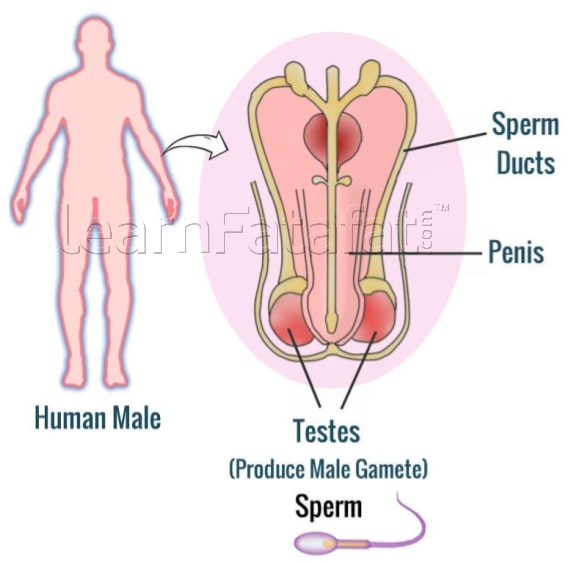
Male Reproductive System
It is particularly consist of testes, vas deferens, penis, scrotum, urethra and glands, seminal vesicle. Among all the parts of male reproductive system, testes is located outside the abdominal cavity. Sperms are the male germ cells which are produced in testes. Moreover, production and storage of sperms require less temperature, hence, testes are located outside the body in scrotum. Particularly, testes are responsible for secretion testosterone. Testosterone brings up changes in appearance in males at the time of puberty. In male reproductive system, sperms are delivered through vas deferens which unites with urethra. Thus. in males, urethra is common passage for urine and sperms. While travelling, sperms receives secretion from prostate gland and seminal vesicles which helps sperms to transport and provide nutrition to sperm. Moreover, sperm consist of genetic material and long tail. Thus, it helps them to move towards female germ cell.
Female Reproductive system
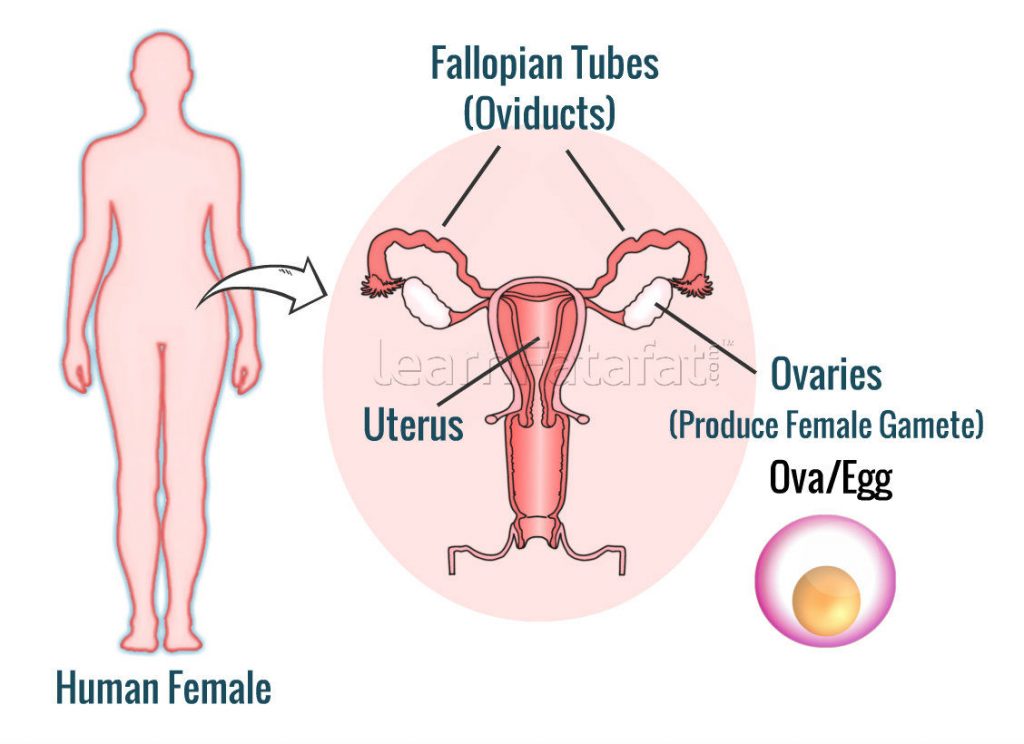
Female Reproductive System
It is consist of pair of ovaries, pair of oviducts, fallopian tube, uterus, cervix and vagina. Germ cell in female is called ova or egg is made in ovaries. When a girl is born ovaries contain thousands of immature eggs. At puberty some of these eggs starts maturing. One of the ovary release one egg every month. Egg is carried to womb with the help of fallopian tube, which opens in uterus. Uterus opens into vagina through cervix. At the time of sexual intercource sperms from male body enter into female body through vagina passage and reach fallopian tube. In fallopian tube sperm fuse with egg and undergo fertilisation to zygote. With time zygote develop into embryo. The embryo receives nutrition from mother’s blood with the help of placenta. Placenta contains villi which helps in obtaining oxygen and glucose from mother’s blood. Child grows in mother’s wombs till nine months. After nine months child is borns because of rhythmic contractions of muscles in uterus.
Menstruation
As previously discussed, ovaries release egg every month, therefore, uterus makes thick and spongy lining to receive egg. If fertilisation did not occur this lining slowly breaks and comes out as blood and mucus. This process is called as menstruation. It happens every month in females and last for two to eight days. This whole process is also known as menstrual cycle.
Keywords: Male reproductive system, Female reproductive system, Menstruation, Menstrual cycle, Sperm, Ovaries

Related articles
Kingdom Plantae
Heredity in Humans
Sex Determination in Human beings
Phylum Vertebrata
Embryo Development