States of Matter

States of matter exist in three states, solid state, liquid state and gaseous state.

States of Matter CBSE 9 Science Chapter 1 Matter in our surroundings

States of Matter

Solid state of matter

Solids have definite shape, size and fixed volume. Particles of solids are held with strong force of attraction, hence, there are less vacant spaces between the particles. This makes solids very less compressible. Moreover, solids are rigid and can break if external force is applied.

Liquid state of matter

Liquids do not have definite shape, but volume of liquid is fixed. Particles in liquid are held with less force of attraction as compared to solid. Hence, there are more vacant spaces present in liquids as compared to solid.
Therefore, liquids are more compressible than solids. Liquids do not possess rigidity as that of solids

Gaseous state of matter

Gases neither have definite shape nor have fixed volume as that of solid and liquid state of matter. Particles in gaseous state of matter have very weak force of attraction, hence, they have large vacant spaces. Therefore, gases are highly compressible. Best example of compressibility of gas can be seen in LPG cylinders used for household purposes. In LPG cylinders, gases are compressed to liquid and then stored in containers.
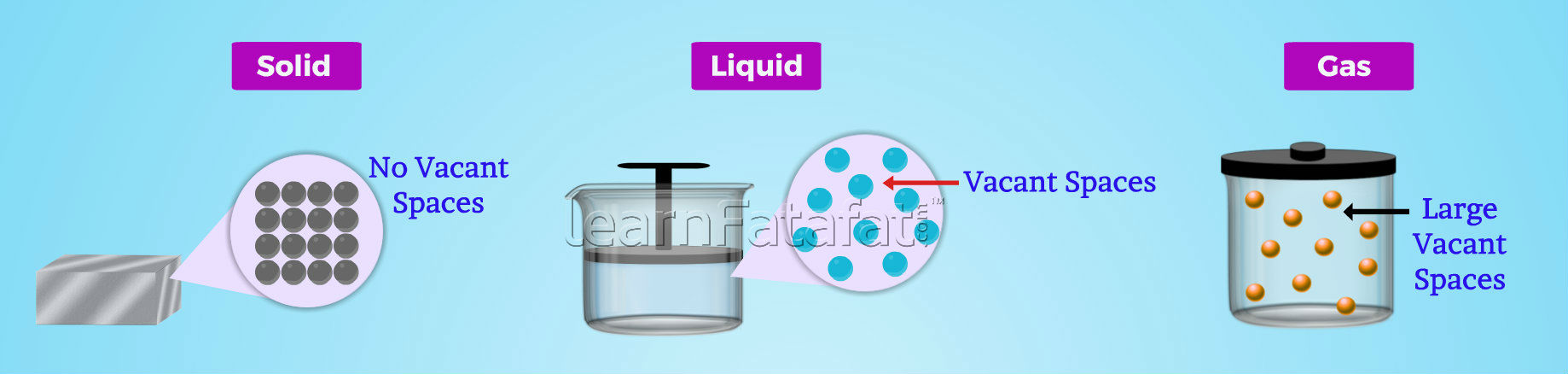
Comparison between States of matter

Properties Solid Liquid Gas
Shape Definite Shape No definite shape No definite shape
Volume Fixed volume Fixed volume No fixed volume
Space No vacant spaces between particles Have small vacant spaces between particles Have large spaces between the particles
Compressibility Less compressible More compressible than solids Highly compressible
Rigidity Possess rigidity Not rigid Not rigid


Change in state of matter
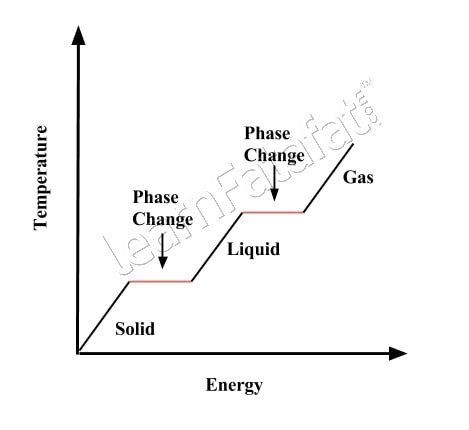
  • Conversion of solid to liquid state: When solid is heated temperature, of solid increases. Increases in temperature increases the kinetic energy of particles. Hence, particles of solid undergo vibration. At an instant, heat energy due to increase in temperature overcomes the force of attraction in particles of solid, hence, they start performing motion. At this stage solid converts into liquid. During the conversion of solid to liquid at certain stage temperature of system becomes constant even if heat is continuously supplied to system. Supplied heat is used to convert solid into liquid state. This heat is known as latent heat of fusion. At atmospheric pressure, the amount of heat required to convert one kilograms of solid to liquid at its melting point is called latent heat of fusion. The temperature at which solid melts to form liquid is called melting point of solid.
  • state of matter

  • Conversion of liquid to gaseous state: When liquid is further heated, heat energy overcomes forces of attraction between the particles of liquids, and ultimately, liquid gets converted to gas. During conversion of liquid to gaseous, at a point the temperature of system remains constant, even if heat is supplied to the system. This heat energy is utilised to convert liquid into gases known as latent heat of vaporization. Amount of heat required to change the unit mass of liquid into vapors at its boiling point under standard atmospheric pressure . At atmospheric pressure, the temperature at which liquid boils and turns into vapour is called as boiling point of liquid.
  • CBSE Class 9 blog promo

  • Conversion of solid to gas: Substances like camphor, ammonium chloride changes from solid to gaseous state without undergoing into liquid state. This process is called sublimation .

states of matter

This article is helpful for Class 9 Science

Keywords: States of matter, Solid, Liquid, Gases, Sublimation, Melting point, Boiling point

Related articles

Reaction Of Metals With Oxygen
Physical Properties Of Metal And Non-metal
Periodic Table And Periodic Trends
Chemistry Of Hydrogen
The Carbon Family

Your email address will not be published. Required fields are marked *

eight + 14 =