


Introduction to Simple Permanent Tissue
Simple permanent tissue and complex permanent tissue are formed when meristematic tissue lose their ability to divide after an extent. Simple permanent tissue is classified into parenchyma, collenchyma & sclerenchyma tissue.
Parenchyma

Simple Permanent Tissue : Parenchyma
This type of simple permanent tissue cells are alive, thin walled, loosely held and possess large intercellular spaces. Also, parenchyma cells stores food and provides support to plant. If parenchyma is consist of chlorophyll, then these cells are capable of preparing food for plants through the process of photosynthesis. Such parenchyma cells are known as chlorenchyma. Aquatic plant floats on water, in this case, parenchyma cells have air filled in the intercellular spaces. Thus, air filled parenchyma cells are known as aerenchyma.
- Epidermis:

Epidermis
It is outermost layer of plant body. As a result, it covers the surface of total plant body. Most of cells in epidermis are parenchyma cells. Epidermis is made up of single layer of cells without intercellular spaces. Moreover, structure of these cells are flattened, also, outer wall is thicker than inner wall of cell. The main function of epidermis is to protect the plants from mechanical injury, entry of fungi, winds, etc. Also, in root, epidermis show hair like structure which absorbs nutrients and water from soil. In desert areas, epidermis of plants are comparatively thick, hence, it prevents loss of water from plant body.
Epidermis also consist of kidney shaped cells called stomata. Stomata is essential for exchange of gases in plants and it is responsible for transpiration i.e. water loss from the plant body
Collenchyma
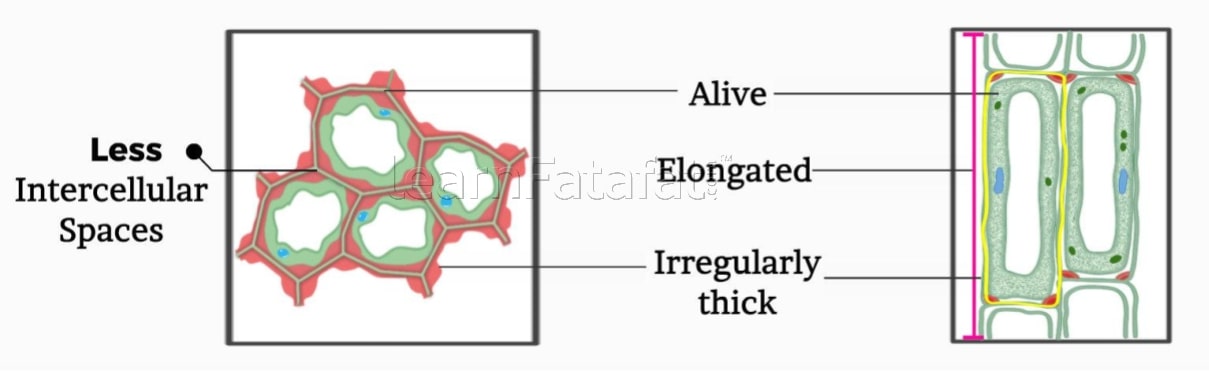
Simple permanent tissue : Collenchyma
Collenchyma tissue is alive. Structure of collenchyma is elongated, walls are irregularly thick and has less intercellular spaces. It is located below the epidermis. Function of Collenchyma is to provide flexibility to plant. Thus, it allows bending of plants without breaking.
Sclerenchyma

Simple Permanent Tissue: Sclerenchyma
Cells in sclerenchyma are all dead cells . Structure of sclerenchyma is long and narrow. Moreover, Wall of sclerenchyma cells are thick and are composed of lignin. Thus, it makes sclerenchyma cells hard. These cells are present in stem around the vascular bundle, in veins of leaves, in covering of seeds, etc. Main function of sclerenchyma cells is to make plant hard and provide strength.
This article is helpful for Class 9 Science
Keywords: Parenchyma, Sclerenchyma, Collenchyma, Epidermis, Stomata, Aerenchyma, Chlorenchyma.

Related articles
Structure and Functions of Plasma Membrane in a Cell
Structure and functions of human eye
Meristematic Tissue in Plants
Working of Human Digestive System
The Process of Photosynthesis
Difference between simple and complex tissues in plants?
Major difference between simple permanent tissue and complex permanent tissue is
simple permanent tissue has same type of cells whereas, complex permanent tissue has different types of cells.
Very nice notes. I use this course. Very helpful course forclass 9
Thanks for the terrific post
Hi Helena,
You can watch videos for this topic in our course. Click here to visit the course
Thanks to the excellent guide