


Class 11 Physics Chapter 8 Gravitation

Stories of planetary motion, theories and phenomena always attracted scientist. Johannes Kepler studied planetary motion and formulated his finding in three laws. In this article let’s talk about kepler’s law in which we will discuss in brief about law of orbits, law of areas and law of periods.
Kepler’s Law of Orbits
It states that,
“All the planets move in elliptical orbit around the sun and sun is present at the focus.”

Kepler’s Law: Law of Orbit
This shows that orbits of the planet have elliptical shape having sun at its focus point. To draw an elliptical shape, take a cardboard and mark two points say f1 and f2, take a string with length greater than distance between points f1 and f2. Fix ends of string to F1 and F2 using pins. With tip of pencil draw a smooth curve keeping the string taut. The complete curve formed is ellipse. For the ellipse f1 and f2 are the foci and the line passing through f1 and f2 meets the ellipse say at point A and P. say a perpendicular bisector PA intersects this line at point O. thus, O is the center of ellipse. For the ellipse traced out by the planet around the sun, the nearest point is called perihelion whereas farthest point is called aphelion. Point P is perihelion and point A shows aphelion. AP = OP +OA known as semi major axis of ellipse. A notable property of ellipse is that the distance measured from one focus to any point present on the ellipse and again to the next focus is always constant.
Kepler’s Law of Areas
It states that,
“Radius vector from sun to the planet, covers equal area in equal time interval”.
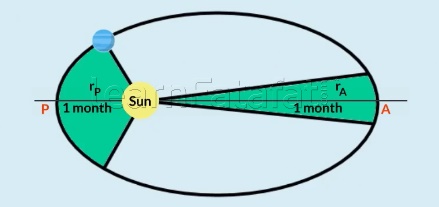
Kepler’s Law : Law of areas
This was concluded from the observation that the planet appear to move slower when they are farther from the sun whereas, it appears to move faster when they are near from the sun.
Mathematically it can be given as angular momentum P = angular momentum A
Lp = L A
mrpvp = mrAvA
∴ vp / vA = rA / rP
It can be easily seen rA > rP thus, vP > vA
Kepler’s Law of Period
It states that,
“Square of time period of revolution of planet is proportional to cube of semimajor axis of ellipse.”
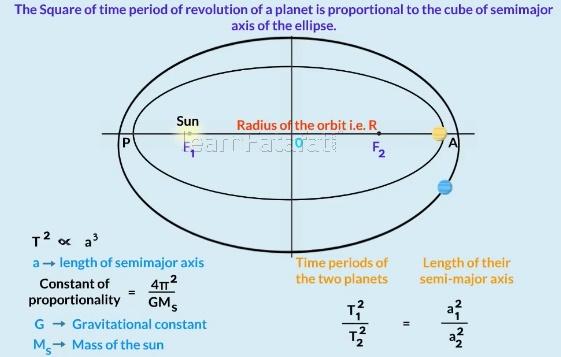
Kepler’s Law: Law of periods
Consider a be the semimajor axis of ellipse, So according to Law of Periods T2 ⍺ a3. Here the constant of proportionality is 4 π2 /GMs, where G is gravitational constant and Ms is the mass of the sun. It is observed that most of the planets have nearly circular orbits so a can be replaced by radius of orbit i.e. R. Similarly, this law helps to compare between time periods of two planets, if we know length of semimajor axes
T12/ T22 = a12 / a22.
Keywords: Kepler’s Law, Perihelion, Aphelion, Law of orbit, Law of Area, Law of period, Gravitation
Related articles
What is Energy?
How does lens in human eye works?
Formation of Lightning in the Sky
Atmospheric Refraction
Doppler Effect