


Class 12 Physics Chapter 2 Electrostatic Potential and Capacitance

Capacitor have an ability to store charge. It is a system of two charged conductors separated by an insulator. The conductor have charges Q1 and Q2 and potentials V1 and V2 respectively. Most of the times there are Q and -Q, with potential difference V= V1 – V2 between them. These conductors are charged by connecting them a battery. However, Q is known as charge of capacitor. Total charge on capacitor is Q-Q=0.
In case of electric field, electric field is proportional charge. Hence, greater the charge on conductors, stronger will be the electric field between them. Moreover, the potential difference between the two conductors is work done to bring unit positive test charge from one conductor to other against electric field. However, if the charge increases, work done will be higher, and thus, potential difference will be higher. Therefore, Q is proportional to V. also, the ratio of Q/V is always constant.
V∝Q
∴ C= Q/V
Here, constant C denotes Capacitance. C is independent of Q and V but it is dependent on size, shape, separation of two conductors and nature of insulator present between the conductors. Also, SI unit of capacitance is farad.
“The capacitance of a capacitor is said to be one Farad when the charge on the conductor is one coulomb and potential difference between the conductor is 1 V”
1F = 1C / V. interestingly, the capacitor with fixed capacitance is represented as whereas, with variable capacitance is represented as. Generally, Farad is large unit, therefore, units 1 µF, 1 nF, 1 pF, etc are used.
Dielectric strength
At high potential difference, strong electric field ionise the surrounding air, and hence, the charges moves towards oppositely charge conductor. It considered as leakage of charge because of poor insulation. The medium is nonconducting and can be specified in terms of dielectric medium. Therefore, “The maximum electric field that dielectric medium withstand without a breakdown is called dielectric strength.” Incase of air it is 3 × 10⁶ V/m .
Parallel plate capacitor
A capacitor with two large plane parallel conducting plates separated by small distance is called parallel plate capacitor. Capacitance of parallel plate capacitor is
C = Q/V = Aε0/d.. Where ε0 is permittivity of free space
A is cross sectional area of one plate
d is distance between the plates
Series and parallel combination of capacitor
- Series combination of capacitor :

Capacitor in Series Combination
In series combination right plate of one capacitor is connected to left plate of other capacitor and end plates are connected to a battery. Consider two capacitor C1 and C2, then expression for capacitor in series combination will be
1/C = 1/C1+1/C2.
For n number of capacitor, the expression becomes,
1/C = 1/C1 + 1/C2 + … + 1/Cn.
This expression gives the equivalent capacitance for series combination. It is defined as,“The reciprocal of total capacitance equal to sum of reciprocal of individual capacitors.” - Parallel combination of capacitor:
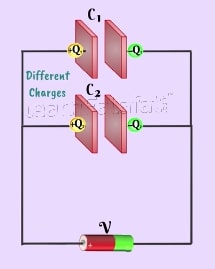
Capacitors in Parallel Combination
In parallel combination right plate of one capacitor is connected to right plate of other capacitor. These are then altogether connected to battery. If C1 and C2 are two capacitors connected in parallel then the expression of parallel combination is
C = C1+C2
However, if n number of capacitors are connected in series then
C = C1 + C2 + … + Cn. This expression gives equivalent capacitance in parallel combination. It can be defined as,“Total capacitance is equal to sum of individual capacitors connected in parallel combination”
Keywords: Capacitance, Capacitor in series combination, Capacitor in parallel combination.
Related articles
What is Energy?
Law of Inertia
Formation of Lightning in the Sky
Rate of motion: Speed, Velocity and Acceleration
How is Rainbow Formed?