

KSEEB SSLC Science Solutions
Chapter 5 Light Reflection And Refraction
LearnFatafat offers free Solutions for SSLC Science Chapter 5 Light Reflection And Refraction. Chapter covers the topics like reflection and refraction of light, spherical mirrors and their image formations, laws of refraction, refraction by spherical lenses, lens formula and more. Check video lessons, notes and MCQ quizzes for SSLC Science Chapter 5 Light Reflection And Refraction click here to buy.
Solutions for SSLC Science Chapter 5 Light Reflection and Refraction
1. Which one of the following materials cannot be used to make a lens?
(a) Water (b) Glass (c) Plastic (d) Clay
Answer: (d) Clay
2. The image formed by a concave mirror is observed to be virtual, erect and larger than the object. Where should be the position of the object?
(a) Between the principal focus and the centre of curvature
(b) At the centre of curvature
(c) Beyond the centre of curvature
(d) Between the pole of the mirror and its principal focus.
Answer: (d) Between the pole of the mirror and its principal focus.
3. Where should an object be placed in front of a convex lens to get a real image of the size of the object?
(a) At the principal focus of the lens
(b) At twice the focal length
(c) At infinity
(d) Between the optical centre of the lens and its principal focus.
Answer: (b) At twice the focal length
4. A spherical mirror and a thin spherical lens have each a focal length of –15 cm. The mirror and the lens are likely to be
(a) both concave.
(b) both convex.
(c) the mirror is concave and the lens is convex.
(d) the mirror is convex, but the lens is concave.
Answer: (a) both concave
5. No matter how far you stand from a mirror, your image appears erect. The mirror is likely to be
(a) plane. (b) concave. (c) convex. (d) either plane or convex.
Answer: (d) either plane or convex
6. Which of the following lenses would you prefer to use while reading small letters found in a dictionary?
(a) A convex lens of focal length 50 cm.
(b) A concave lens of focal length 50 cm.
(c) A convex lens of focal length 5 cm.
(d) A concave lens of focal length 5 cm.
Answer: (c) A convex lens of focal length 5 cm.
7. We wish to obtain an erect image of an object, using a concave mirror of focal length 15 cm. What should be the range of distance of the object from the mirror? What is the nature of the image? Is the image larger or smaller than the object? Draw a ray diagram to show the image formation in this case.
Answer:
Ray diagram-

Range of distance of the object from the mirror is 0 to 15 cm
Nature of the image is virtual and erect
Image formed is larger than the object.
8. Name the type of mirror used in the following situations.
(a) Headlights of a car.
(b) Side/rear-view mirror of a vehicle.
(c) Solar furnace. Support your answer with reason.
Answer:
(a) Headlights of a car – In headlights of the car, concave mirrors are used . When light source is placed at the principal focus of concave mirror it produces powerful parallel beam of light.
(b) Side/rear-view mirror of a vehicle – Convex mirrors are used in rear view of vehicle as it provides large surface to view.
(c) Solar furnace – Concave mirror is used in solar furnace as it concentrates parallel rays of the sun at the principal focus.
9. One-half of a convex lens is covered with a black paper. Will this lens produce a complete image of the object? Verify your answer experimentally. Explain your observations.
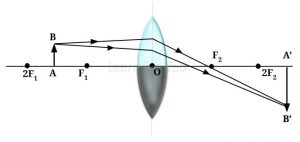
Answer: A complete image is formed by convex lens even if one half of lens is covered with black paper. Consider following situations –
Situation 1 : When upper half is covered with black paper – In this case, ray of light coming from the object is refracted by the lower half of the lens. When these rays meet at the other end of the lens, image of the object is formed.
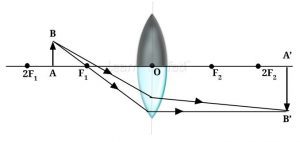
Situation 2 : When lower half is covered with black paper – In this case, ray of light coming from the object is refracted by the upper half the lens. When these rays meet at the other end of the lens, image of the object is formed.
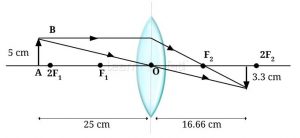
10. An object 5 cm in length is held 25 cm away from a converging lens of focal length 10 cm. Draw the ray diagram and find the position, size and the nature of the image formed.
Answer: Given
Object distance u = -25cm
Object height ho= 5 cm
Focal length f = 10 cm
Consider lens formula,
(1/v) – (1/u) = 1/f
1/v = (1/u) + (1/f)
= 1/-25 + 1/ 10
= (1/10) – (1/25)
= 15 /250
v = 250 / 15
= 16.66 cm
Image distance v is positive, i.e. image is formed at other end of the lens
Using magnification formula,
Magnification m = – v/ u = – 16.66 / 25 = -0.67
Negative sign of magnification shows that image is real and is formed behind the lens.
Also m = image height hi / object height ho
∴ hi = m x ho
= – 0.67 x 5
= – 3.33 cm
Negative image height show that image is inverted. Therefore, following ray diagram shows the position, size and nature of the image.
Diagram:
11. A concave lens of focal length 15 cm forms an image 10 cm from the lens. How far is the object placed from the lens? Draw the ray diagram.
Answer:
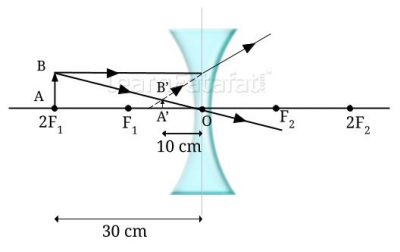
Given focal length f = -15cm
Image distance v = – 10 cm
∴ by using lens formula,
(1/v) – (1/u) = (1/f)
1/u = (1/v) – (1/f)
= (-1/10) – (1/-15)
= (-1/10) + (1/15)
= (1/15) – (1/10)
= -5 / 150
u = -150/ 5 = -30 cm
Negative value of object distance suggest that image is formed 30 cm in front of the lens.
12. An object is placed at a distance of 10 cm from a convex mirror of focal length 15 cm. Find the position and nature of the image.
Answer: Given: Focal length of convex mirror (f) = 15 cm
Object distance (u) = – 10 cm
Using mirror formula,
(1/v) + (1/u) = 1/f
1/v = 1/f – 1/u
= (1/15) – (-1/10)
= (1/15) + (1/10)
= 25 / 150
v = 6 cm
Positive image distance suggest that image is formed behind the mirror.
Magnification (m) = – image distance / object distance = – v / u = – 6/ -10 = 0.6
13. The magnification produced by a plane mirror is +1. What does this mean?
Answer: Magnification by the plane mirror +1. This suggest that, image of the object formed by the plane mirror has same size as that of the object. Moreover, positive value of magnification shows that image formed is virtual and erect.
14. An object 5.0 cm in length is placed at a distance of 20 cm in front of a convex mirror of radius of curvature 30 cm. Find the position of the image, its nature and size.
Answer: Given: Object distance (u) = -20 cm
Height of object (ho) = 5 cm
Radius of curvature (R) = 30cm
Using the formula
Radius of curvature (R) = 2 x focal length (f)
∴ f = R/2
∴ f = 30 / 2
∴ f = 15 cm
By using mirror formula,
(1/v) + (1/u) = 1/f
∴ 1/v = (1/f) – (1/u)
∴ 1/v = (1/15) – (1/-20)
∴ 1/v = (1/15) + (1/20)
∴ 1/v = (4+3) / 60
∴ 1/v = 7 / 60
∴ v = 60/7 = 8.57 cm
Positive image distance suggest that image is formed behind the mirror.
Magnification (m) = – image distance / object distance = – 8.57 / – 20 = 0.43
Image formed is virtual as magnification is positive.
Magnification (m) = image height (hi) / object height (ho)
hi = m x ho = 0.43 x 5 = 2.14 cm
Positive image height suggest that image formed by the object is erect. Therefore, image formed is virtual, erect and smaller in size as compared to object.
15. An object of size 7.0 cm is placed at 27 cm in front of a concave mirror of focal length 18 cm. At what distance from the mirror should a screen be placed, so that a sharp focussed image can be obtained? Find the size and the nature of the image.
Answer: Given: Distance of object (u) = -27 cm
Height of object (ho) = 7 cm
Focal length (f) = -18 cm
By using mirror formula,
(1/v) + (1/u) = 1/f
∴ 1/v = (1/f) – (1/u)
∴ 1/v = (-1/18) + (1/27)
∴ 1/v = (1/27) – (1/18)
∴ 1/v = -1 / 54
∴ v = – 54
Negative value of image distance v suggest that screen should be placed 54 cm before the mirror.
Magnification (m) = – Image distance / Object distance = -54 / 27 = -2
Negative magnification suggest that image formed by the object is real.
Magnification (m) = Image height (hi) / Object height (ho) =
hi = m x ho = -2 x 7 = – 14 cm
Negative image height suggest that image formed by the object is inverted.
16. Find the focal length of a lens of power – 2.0 D. What type of lens is this?
Answer: Given : Power of lens P = -2.0 D
We know that, Power of lens P = 1 / f
f = 1 / P
f = 1 / (-2)
∴ f = – ½ or – 0.5m
Focal length f is negative, therefore lens is concave lens.
17. A doctor has prescribed a corrective lens of power +1.5 D. Find the focal length of the lens. Is the prescribed lens diverging or converging?
Answer: Given : Power of lens (P) = +1.5D
Using formula for power of lens
P = 1/f
∴ f = 1/P = 1 / 1.5 = 0.66 m
KSEEB SSLC
Access SSLC video lessons online (internet required) or offline(internet not required) in SD Card, Pendrive, DVD, Tablet.
Chapter 5 Light Reflection And Refraction


