- Production of Sound: Sound is produced by vibration of sound
- Propagation of sound:
- Sound requires medium for propagation. Medium can be solid or liquid or gas.
- When object undergo vibration surrounding particles of medium undergo motion. Moving particles exerts force on adjacent particles and returns back to its original position. Adjacent particle perform similar motion.
- Particle in medium do not move with wave only, the disturbance in the wave moves.
Click here to watch video on Production and Propagation of Sound
- Compression: Vibration of objects pushes and compresses air in front, creating region of high pressure called compression.
- Rarefaction: When object moves backward, it creates area of low pressure called rarefaction.
- Longitudinal waves: Waves in which particles of medium show displacement, parallel to direction of wave propagation.
- Transverse waves: Waves in which particles of medium show displacement perpendicular to direction of wave propagation.
- Comparison between longitudinal waves and transverse waves:
Longitudinal Wave Transverse Wave Waves in which particle of medium propagates parallel to direction of wave propagation are longitudinal wave Wave in which particle of medium propagates perpendicular to direction of propagation of waves are called as transverse wave Wave have compression and rarefactions Waves have crests and troughs Medium of longitudinal waves can be solid, liquid and gases Medium of transverse is only solid E.g: Sound waves E.g: Light waves - Sound waves are longitudinal waves: Sound waves show same mechanism as that of longitudinal waves as particles of medium travels parallel to direction of propagation of sound waves.
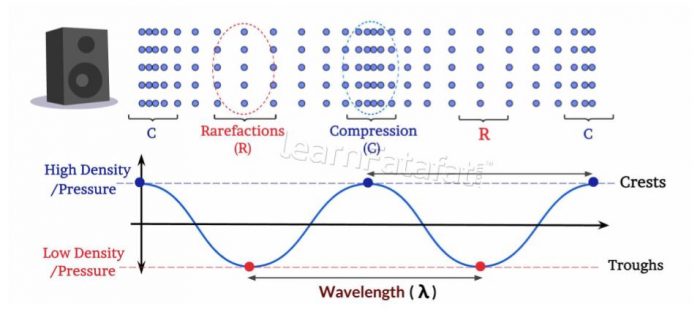
- Compression or Crests:
- Peak in graph
- Region of high density or pressure of particles
- Rarefaction or troughs:
- Valley in graph
- Region of lower density or pressure of particles.
- Characteristics of Sound waves:
- Wavelength(λ): Distance between two consecutive compression or two consecutive rarefactions. SI unit: metre (m)
- Frequency(?): Number of oscillation per unit time. SI unit: Hertz (Hz)
- Time Period (T): Time required to complete one oscillation. SI unit: seconds (s)
- Relation between time and frequency: ? = 1/T
- Speed(v):
- It is a distance that a point on wave, either a compression or a rarefaction travelling per unit time.
- Mathematical expression: v= λ / T or v = λ? ; where T is time, λ= wavelength, ?= frequency.
- SI unit: m/s
- From solid to gaseous state speed of sound decreases.
- If temperature is increased speed of sound also increases.
- Pitch:
- Sensation of frequency of sound is called as pitch.
- Higher frequency of sound waves higher will be the frequency, and vice versa.
- Amplitude(A) or Energy of Sound: Magnitude of maximum disturbance in the medium on either side of its mean position. SI unit: metre (m).
- Loudness and Softness:
- Louder the sound, higher is the energy and vice versa.
- Loud sound travels larger distance, soft sound travels smaller distance.
- As the sound waves moves away from the source, amplitude of sound decreases.
- Quality or Timbre:
- Sound of single frequency is called as tone
- Sound with two or more frequency called as note
- Sound which is good to hear is of good quality
- Sound which is bad to hear is of bad quality
- Intensity: Amount of energy carried by sound wave per unit area.
- Reflection of sound waves:
- Reflection of sound occurs when sound waves return backs from solid or liquid surfaces.
- Medium of sound waves before and after reflection is same.
- Angle of incidence of sound waves is equal to angle of reflection of sound waves
- Incident ray reflected ray and normal lie in same plane.
- Echo:
- Sound which is heard again due to the reflection of sound from reflecting surface is called as an echo.
- Sound produced and reflected sound must have difference of 0.1 seconds.
- Reflecting surface must be present at half the distance travelled by the sound.
- Reverberation:
- Continuation of sound due to multiple reflections
- Generally found in big halls
- To reduce reverberation, big hall are covered with sound absorbents like curtains, fibre boards, etc.
- Uses of Reflection of Sound:
- Megaphones, horns are made up with conical tube like structure. It reflects maximum of sound from the source towards the audience, and avoids spreading of sound in all directions.
- Stethoscope used by doctors, receives the sound from body organs, by multiple reflections, and finally reaches to doctors ear.
- Ceilings of concert halls and cinema halls are curved, so that, sound undergo reflection and reach to each and every corner of the hall. Curved sound board is placed behind the stage so that after reflection, sound is equally spread across the width of the hall.
- Range of hearing:
Range Who can hear / produce? Audible range for humans 20 Hz to 20000 Hz Humans and animals Infrasonic Sound Below 20 Hz Whale, Elephants, etc Ultrasonic sound Above 20000 Hz Moths, Dolphins, Bats, Porpoises, etc. - Applications of Ultrasound:
- Cleaning: Ultrasound is passed through parts of object which are out of human reach. Waves removes the dirt and clean the object.
- In detection of cracks: Ultrasound is passed through the structures, if there is presence of crack then sound waves are reflected back. Showing presence of crack.
- Echocardiography: Ultrasound waves are passed through heart which takes various images of heart.
- Ultrasonography: It detects defects in organs. Ultrasound is passed through the tissues, in case of defects, waves are reflected back, indicating presence of defects. This technique is also used to inspect fetus during pregnancy.
- To break kidney stones: Ultrasound is used to break kidney stones into fine particles. These are later removed through urine.
- SONAR (SOund Navigation And Ranging):
- Working: SONAR consist of transmitter and receiver. Transmitter transmits ultrasound waves. Waves strikes with objects under water or seabed and reflects back. Reflected waves are received by receiver, and gets converted to electrical signals. Later signal are inspected to know underwater condition.
Total distance (D) travelled by ultrasound is= 2 × depth of sea(d) = 2 d
We know that, speed = distance(D) / time(t)
∴ v = 2d /t
∴ Depth of sea is d = ( v × t ) / 2
- Applications: Detect underwater objects, measure the depth of sea, in locating submarines underwater, sunken ships, etc.
- Bats use similar technique in which they emit ultrasound. This sound gets reflected from prey present in surrounding. Intensity of reflected sound helps the bat to judge distance between bat and prey.
- Working: SONAR consist of transmitter and receiver. Transmitter transmits ultrasound waves. Waves strikes with objects under water or seabed and reflects back. Reflected waves are received by receiver, and gets converted to electrical signals. Later signal are inspected to know underwater condition.
- Structure of Human Ear:

- Outer Ear: Pinna collects sound from surrounding and passes through auditory canal which further joins the eardrum.
- Middle Ear:
- When sound waves reaches eardrum, it pushes eardrum inward and forms compression, when eardrum moves outward it forms rarefactions. This creates vibration of ear drum.
- Vibrations are amplified by hammer, anvil and stirrup.
- Inner Ear: Amplified signals are passed to cochlea, which converts it into electrical signals. These signals are passed to brain through auditory nerve.
Textbook simplified in Videos