

NCERT Solutions for Class 7 Science
Chapter 9 Soil
LearnFatafat offers free NCERT Solutions for Class 7 Science Chapter 9 Soil. Chapter covers the topics like soil, importance of soil, formation of soil, properties of soil, types of soil, crops suitable to different soil types, soil profile and more. Check video lessons for Class 7 Science Chapter 9 Soil click here to buy.
LearnFatafat offers free NCERT Solutions for Class 7 Science Chapter 9 Soil. Chapter covers the topics like soil, importance of soil, formation of soil, properties of soil, types of soil, crops suitable to different soil types, soil profile and more. Check video lessons for Class 7 Science Chapter 9 Soil click here to buy.
NCERT Solutions for Class 7 Science Chapter 9 Soil
Tick the most suitable answer in questions 1 and 2.
1. In addition to the rock particles, the soil contains
(i) air and water
(ii) water and plants
(iii) minerals, organic matter, air and water
(iv) water, air and plants
Answer: minerals, organic matter, air and water
2. The water holding capacity is the highest in
(i) sandy soil ii) clayey soil (iii) loamy soil
(iv) mixture of sand and loam
Answer: clayey soil
3. Match the items in Column I with those in Column II:
| Column I | Column II |
|---|---|
| A home for living organisms | Large particles |
| Upper layer of the soil | All kinds of soil |
| Sandy soil | Dark in colour |
| Middle layer of the soil | Small particles and packed tight |
| Clayey soil | Lesser amount of humus |
Answer:
| Column I | Column II |
|---|---|
| A home for living organisms | All kinds of soil |
| Upper layer of the soil | Dark in colour |
| Sandy soil | Large particles |
| Middle layer of the soil | Lesser amount of humus |
| Clayey soil | Small particles and packed tight |
4. Explain how soil is formed.
Answer: Soil formation takes place through the process of weathering. In this process, rock breaks down into small fragments and later into fine particles called soil by the action of wind, water, sun and climate.
5. How is clayey soil useful for crops?
Answer: Particles in clayey soil are very small in size. Therefore, particles of clayey soil are tightly packed with each other, leaving small space for air. This increases water holding capacity of soil. Also, clayey soil is rich in organic matter. Due to all these properties, clayey soil proves helpful for crops.
6. List the differences between clayey soil and sandy soil.
Answer:
| Clayey soil | Sandy soil |
|---|---|
| Soil particles are smaller in size | Soil particles are larger in size |
| Soil particles are tightly packed | Soil particles are loosely held |
| High water holding capacity | Low water holding capacity |
| Amount of air trapped inside the soil particles is less | Amount of air trapped in the soil particles is more |
| Soil contains large quantity of organic matter | Soil contains small quantity of organic matter |
| Suitable for crop production | Not suitable for crop production |
7. Sketch the cross section of soil and label the various layers.
Answer:
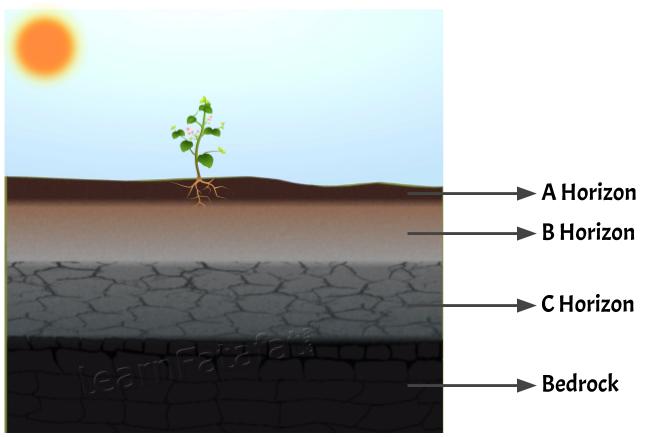
8. Razia conducted an experiment in the field related to the rate of percolation. She observed that it took 40 min for 200 mL of water to percolate through the soil sample. Calculate the rate of percolation.
Answer: Given: 1) Amount of water = 200ml, 2) Percolation time = 40 min.
We know that, percolation rate = amount of water in ml / percolation time in min
Therefore, Percolation rate = 200 / 40 = 5 ml/min
9. Explain how soil pollution and soil erosion could be prevented.
Answer:
- Soil pollution – Mixing or increase of harmful substances in the soil is called soil pollution. To prevent soil pollution following measures should be taken-
- Avoid mixing of factory water and household garbage into to the soil. Factory waste should be treated using chemicals before letting into the soil to avoid harm to the soil. Household waste should be dumped into bins.
- Plastic waste should be disposed using proper disposal methods. Never let plastic waste into the soil, as it decreases soil fertility.
- Fertility of soil decreases due to excess use of insecticides or pesticides. To avoid this manure can be used instead of chemical fertilizers.
- Soil erosion – Removal of top layer of soil due to factors like wind, air, etc is called soil erosion. In following ways soil erosion can be prevented.
- Plant more and more trees. Roots of trees holds top layer of soil tightly, thereby preventing it from getting carried way through wind or rain.
- Avoid cutting of trees (deforestation) and promote reforestation.
10. Solve the following crossword puzzle with the clues given:

- Across: 2. Plantation prevents it. 5. Use should be banned to avoid soil pollution. 6. Type of soil used for making pottery. 7. Living organism in the soil.
- Down: 1. In desert soil erosion occurs through. 3. Clay and loam are suitable for cereals like. 4. This type of soil can hold very little water. 5. Collective name for layers of soil.
Answer:

Check other lessons NCERT Solutions for Class 7
Download free NCERT textbook class 7 Science – Chapter 9 Soil
CBSE Class 7
Access Class 7 video lessons online (internet required) or offline(internet not required) in SD Card, Pendrive, DVD, Tablet.
Chapter 9 – Soil


