

NCERT Solutions for Class 7 Science
Chapter 18 Wastewater Story
LearnFatafat offers free NCERT Solutions for Class 7 Science Chapter 18 Wastewater Story. Chapter covers the topics like wastewater and sewage, wastewater treatment plant, how to reduce waste generation, sanitation and disease and more. Check video lessons for Class 7 Science Chapter 18 Wastewater Story click here to buy.
NCERT Solutions for Class 7 Science Chapter 18 Wastewater Story
1. Fill in the blanks:
(a) Cleaning of water is a process of removing ____________.
Answer: pollutants
(b) Wastewater released by houses is called ____________.
Answer: sewage
(c) Dried ____________ is used as manure.
Answer: dung
(d) Drains get blocked by ____________ and ____________.
Answer: plastics, sludge and metal waste
2. What is sewage? Explain why it is harmful to discharge untreated sewage into rivers or seas
Answer: Wastewater containing solid as well as liquid waste is called sewage. Generally, sewage is generated in houses, industries, etc. Sewage waste contains contaminated food material from homes, harmful chemicals from industries and more waste, that can prove harmful for aquatic animals. If such water is consumed by humans, it could cause harmful diseases.
3. Why should oils and fats be not released in the drain? Explain.
Answer: If oils and fats are released in the drain then they hardens and block the sewage pipes. In drainage, oils and fats blocks porosity of soil. Therefore, oils and fats should not be released in the drains.
4. Describe the steps involved in getting clarified water from wastewater.
Answer: Following are steps involved in getting clarified water from wastewater-
- Wastewater is passed through screens, which removes solid impurities like stones, plastics, metals,etc.
- This water is then passed to sedimentation tank. Here, solids or sludge settles at the base of the tank, which is then removed.
- Water free from sludge is passed through aerator to remove other impurities.
- Further, this water is passed to for chlorination which kills bacteria and other disease causing germs.
5. What is sludge? Explain how it is treated.
Answer: Sludge is solid waste settled at the bottom of the tank during wastewater treatment. Sludge is taken from the tank and is allowed to get decomposed by anaerobic bacteria which in return produced biogas. Biogas can be further used as a low cost fuel.
6. Untreated human excreta is a health hazard. Explain.
Answer: Human excreta is a health hazard because, it causes air and soil pollution. When these get mixed with sources of water it pollutes water. If such water is consumed, it causes diseases like cholera, diarrhoea and more. This can cause death.
7. Name two chemicals used to disinfect water.
Answer: Chlorine and ozone is used to disinfect water.
8. Explain the function of bar screens in a wastewater treatment plant.
Answer: Bar screens are the mesh like structure, that restricts the passage of solids. Through bar screens only water and fine solids are passed further.
9. Explain the relationship between sanitation and disease.
Answer: Sanitation and disease are interrelated to each other. If there is less sanitation then there is growth of disease. It pollutes environment causing various diseases. Thus, to stay disease free sanitation is important.
10. Outline your role as an active citizen in relation to sanitation.
Answer:
- Spread awareness about sanitation and its benefits.
- Maintain personal hygiene.
- Municipal corporation should work properly in cleaning and covering drains, cleaning public garbage bins.
- Avoid open defecations and promoting proper measures to maintain sanitation in locality.
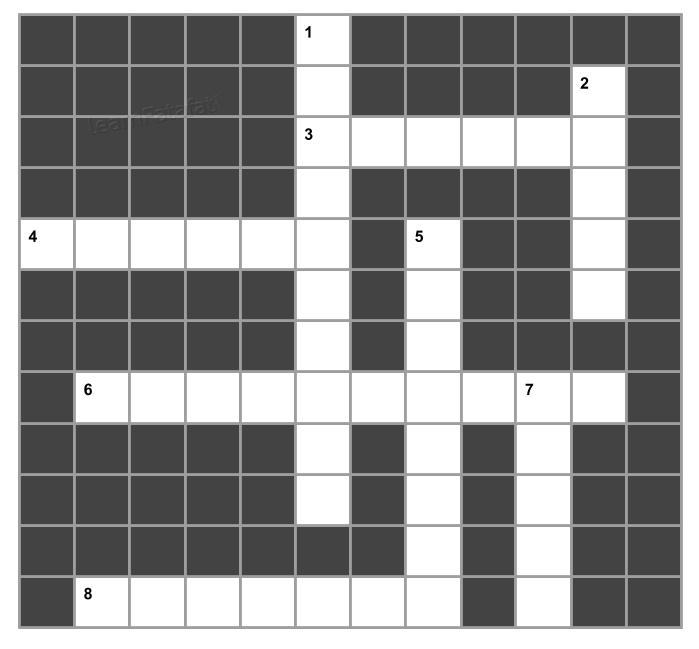
11. Here is a crossword puzzle: Good luck!
- Across: 3. Liquid waste products 4. Solid waste extracted in sewage treatment 6. A word related to hygiene 8. Waste matter discharged from human body
- Down: 1. Used water 2. A pipe carrying sewage 5. Microorganisms which causes cholera 7. A chemical to disinfect water
Answer:
- Across: 3. Sewage 4. Sludge 6. Sanitation 8. Excreta
- Down: 1. Wastewater 2.sewer 5. Bacteria 7. ozone

12. Study the following statements about ozone:
(a) It is essential for breathing of living organisms.
(b) It is used to disinfect water.
(c) It absorbs ultraviolet rays.
(d) Its proportion in air is about 3%.
Which of these statements are correct?
(i) (a), (b) and (c) (ii) (b) and (c) (iii) (a) and (d) (iv) All four
Answer: (ii) (b) and (c)
Check other lessons NCERT Solutions for Class 7
Download free NCERT textbook class 7 Science – Chapter 18 Wastewater Story
CBSE Class 7
Access Class 7 video lessons online (internet required) or offline(internet not required) in SD Card, Pendrive, DVD, Tablet.
Chapter 18 – Wastewater Story


