

NCERT Solutions for Class 7 Science
Chapter 10 Respiration in Organisms
LearnFatafat offers free NCERT Solutions for Class 7 Science Chapter 10 Respiration in Organisms. Chapter covers the topics like breathing and breathing rate, respiration and need of respiration, human respiratory system, breathing in animals, respiration in plants and more. Check video lessons for Class 7 Science Chapter 10 Respiration in Organisms click here to buy.
NCERT Solutions for Class 7 Science Chapter 10 Respiration in Organisms
1. Why does an athlete breathe faster and deeper than usual after finishing the race?
Answer: During race an athlete require more energy. Thus, more amount of oxygen is required to release more energy. For this reason, an athlete breathes faster in order to take in more amount of oxygen.
2. List the similarities and differences between aerobic and anaerobic respiration.
Answer:
- Similarities: In both respiration, glucose is broken down to release energy.
- Difference:
Aerobic respiration Anaerobic respiration Breaking of glucose in presence of oxygen is called aerobic respiration. Breaking of glucose in absence of oxygen is called anaerobic respiration. Breakdown results in the formation of carbon dioxide, water and energy Breakdown results in formation of carbon dioxide or lactic acid, alcohol and energy Energy produced is in large amount Energy produced is in small amount Aerobic respiration is generally found on plants and animals Anaerobic respiration is generally found in yeast, bacteria, etc.
3. Why do we often sneeze when we inhale a lot of dust-laden air?
Answer: Sneezing restricts the entry of unwanted particles through air in our body and allows only clean air to enter. When we inhale dust laden air, it causes irritation in upper part of the nose, thus we sneeze to throw dust particle out.
4. Take three test-tubes. Fill ¾th of each with water. Label them A, B and C. Keep a snail in test-tube A, a water plant in test-tube B and in C, keep snail and plant both. Which test-tube would have the highest concentration of CO2?
Answer: Test tube A contains snail. Snail breathes in oxygen and breathe out carbon dioxide. Test tube B contains plant. Plants take carbon dioxide and releases oxygen. In test tube C contains snail and plant. Carbon dioxide released by snail is taken in by plant and in return plant releases oxygen, which is used by snail for breathing. Thus, comparing all 3 test tubes – in test tube C proportion of oxygen and carbon dioxide will be balanced. In test tube B there will be more concentration of oxygen and in test tube A will have highest concentration of CO2.
5. Tick the correct answer:
(a) In cockroaches, air enters the body through
(i) lungs (ii) gills (iii) spiracles (iv) skin
Answer: spiracles
(b) During heavy exercise, we get cramps in the legs due to the accumulation of
(i) carbon dioxide (ii) lactic acid (iii) alcohol (iv) water
Answer: lactic acid
(c) Normal range of breathing rate per minute in an average adult person at rest is:
(i) 9–12 (ii) 15–18 (iii) 21–24 (iv) 30–33
Answer: 15–18
(d) During exhalation, the ribs
(i) move outwards (ii) move downwards (iii) move upwards (iv) do not move at all
Answer: move downwards
6. Match the items in Column I with those in Column II:
| Column I | Column II |
|---|---|
| (a) Yeast | (i) Earthworm |
| (b) Diaphragm | (ii) Gills |
| (c) Skin | (iii) alcohol |
| (d) leaves | (iv) chest cavity |
| (e) fish | (v) stomata |
| (f) frog | (vi) lungs and skin |
| (vii) tracheae |
Answer:
| Column I | Column II |
|---|---|
| (a) Yeast | (iii) alcohol |
| (b) Diaphragm | (iv) chest cavity |
| (c) Skin | (i) Earthworm |
| (d) leaves | (v) stomata |
| (e) fish | (ii) Gills |
| (f) frog | (vi) lungs and skin |
7. Mark ‘T’ if the statement is true and ‘F’ if it is false:
(i) During heavy exercise the breathing rate of a person slows down. (T/F)
Answer: False. [ During heavy exercise breathing rate of a person increases, to provide more energy to the body. ]
(ii) Plants carry out photosynthesis only during the day and respiration only at night. (T/F)
Answer: False. [ Respiration is carried out by plants in day as well as night. ]
(iii) Frogs breathe through their skins as well as their lungs. (T/F)
Answer: True.
(iv) The fishes have lungs for respiration. (T/F)
Answer: False. [ Fishes have gills for respiration. ]
(v) The size of the chest cavity increases during inhalation. (T/F)
Answer: True
8. Given below is a square of letters in which are hidden different words related to respiration in organisms. These words may be present in any direction — upwards, downwards, or along the diagonals. Find the words for your respiratory system. Clues about those words are given below the square.

- The air tubes of insects
- Skeletal structures surrounding chest cavity
- Muscular floor of chest cavity
- Tiny pores on the surface of leaf
- Small openings on the sides of the body of an insect
- The respiratory organs of human beings
- The openings through which we inhale
- An anaerobic organism
- An organism with tracheal system
Answer:
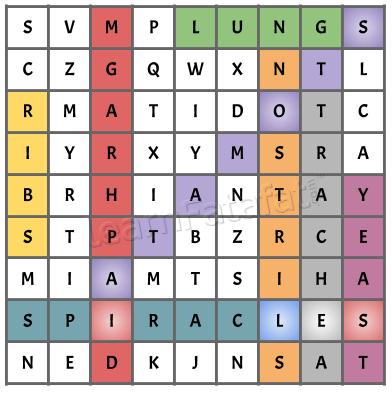
- Trachea
- Ribs
- Diaphragm
- Stomata
- Spiracles
- Lungs
- Nostrils
- Yeast
- Cockroach
9. The mountaineers carry oxygen with them because:
(a) At an altitude of more than 5 km there is no air.
(b) The amount of air available to a person is less than that available on the ground.
(c) The temperature of air is higher than that on the ground.
(d) The pressure of air is higher than that on the ground.
Answer: (b) The amount of air available to a person is less than that available on the ground.
Check other lessons NCERT Solutions for Class 7
Download free NCERT textbook class 7 Science – Chapter 10 Respiration in Organisms
CBSE Class 7
Access Class 7 video lessons online (internet required) or offline(internet not required) in SD Card, Pendrive, DVD, Tablet.
Chapter 10 – Respiration in Organisms


