

NCERT Solutions for Class 7 Science
Chapter 1 Nutrition in Plants
LearnFatafat offers free NCERT Solutions for Class 7 Science Chapter 1 Nutrition in Plants. Chapter covers the topics like autotrophs and heterotrophs, process of photosynthesis, modes of nutrition in plants, nitrogen fixation, nitrogen cycle and more. Check video lessons for Class 7 Science Chapter 1 Nutrition in Plants click here to buy.
NCERT Solutions for Class 7 Science Chapter 1 Nutrition in Plants
1. Why do organisms take food?
Answer: Living organisms need food for survival. Food provides energy and essential nutrients for growth and development of body.
2. Distinguish between a parasite and a saprotroph.
Answer:
| Parasite | Saprotroph |
|---|---|
| Organisms that grows on the body of other living organisms to meet their nutritional demands are parasites. | Organisms that derives nutrients from dead and decaying bodies are saprotrophs. |
| Parasite mostly lives inside or on the body of organisms. | Saprotrophs lives on dead or decaying matter. |
| E.g. Tapeworms, Fleas, etc | E.g. Yeast, Mushroom, etc |
3. How would you test the presence of starch in leaves?
Answer: The presence of starch in leaves can be detected by iodine test. When iodine solutions comes in contact with starch, there is appearance of dark blue color. So, put few drops on iodine solution on leaf, if leaf show traces of dark blue color then starch is present, else starch is absent.
4. Give a brief description of the process of synthesis of food in green plants.
Answer: Plants synthesise food by the process of photosynthesis. The main events in the process of photosynthesis are as follows –
- Absorption of light energy by chlorophyll: Leaves of Green plant contain chloroplast which consists of green pigment called chlorophyll. Chlorophyll absorb light energy.
- Light Reaction or the Photochemical Phase: The absorbed light energy is converted by chlorophyll into chemical energy which is stored as ATP. Plant roots absorb water from the soil which is then transported to leaves of the plant and other parts. In the chloroplast, the chemical energy is used to split water molecules producing hydrogen and oxygen. Oxygen formed during this phase is released in the atmosphere.
- Dark Reaction: The surface of green leaves has small pores called stomata. Carbon dioxide molecules enter in the leaves through stomata. In the stroma of chloroplast, hydrogen produced during light reaction is used to reduce carbon dioxide into glucose. Excess of glucose is stored in the form of carbohydrates in the fruit or foodgrains of the plant.
- It is not necessary that all these steps take place at the same time. e.g. In desert, plants absorb carbon dioxide during night and prepares an intermediate product. During day when sunlight is available this product is converted to carbohydrates.
Photosynthesis equation –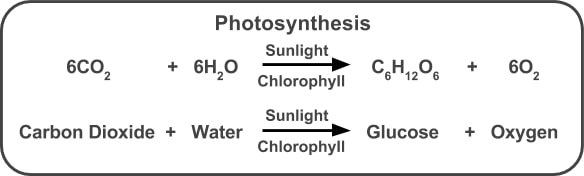
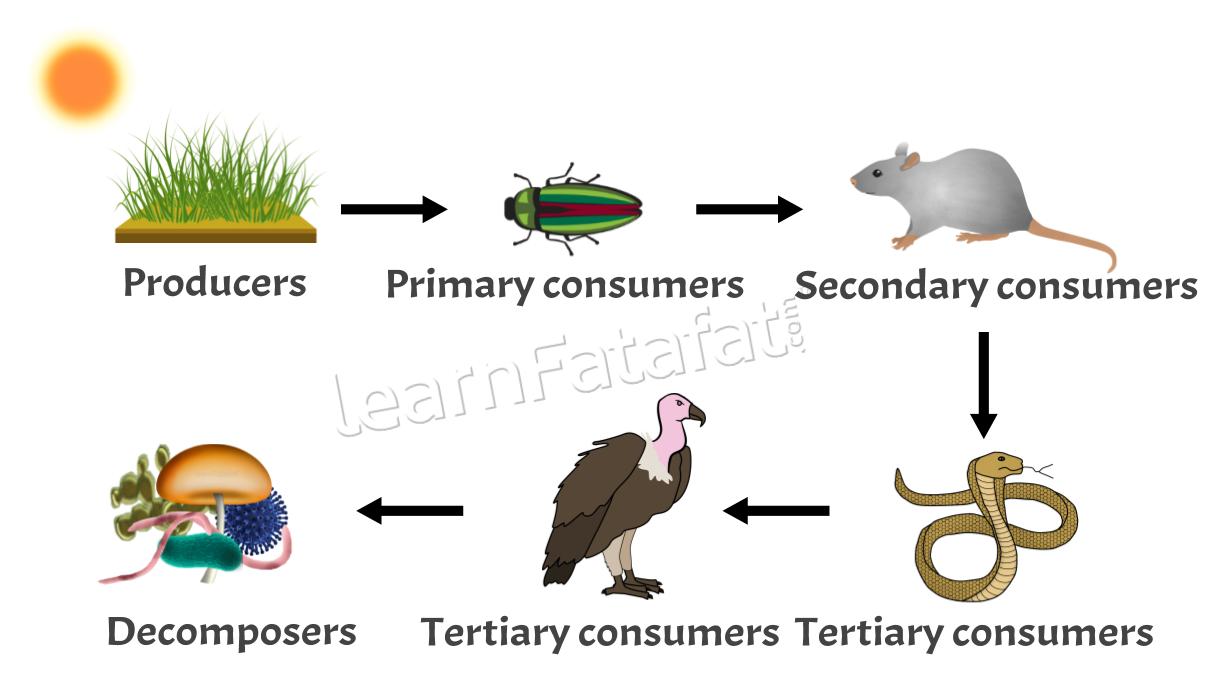
5. Show with the help of a sketch that plants are the ultimate source of food.
Answer:
6. Fill in the blanks:
(a) Green plants are called ______________ since they synthesise their own food.
Answer: autotrophs
(b) The food synthesised by plants is stored as _________________.
Answer: starch
(c) In photosynthesis solar energy is absorbed by the pigment called___________.
Answer: chlorophyll
(d) During photosynthesis plants take in _______________ and release ______________ gas.
Answer: carbon dioxide, oxygen
7. Name the following:
(i) A parasitic plant with yellow, slender and branched stem.
Answer: Cuscuta.
(ii) A plant that is partially autotrophic.
Answer: Pitcher plant.
(iii) The pores through which leaves exchange gases.
Answer: Stomata.
8. Tick the correct answer:
(a) Cuscuta is an example of:
(i) autotroph (ii) parasite (iii) saprotroph (iv) host
Answer: parasite
(b) The plant which traps and feeds on insects is:
(i) Cuscuta (ii) china rose (iv) pitcher plant (iv) rose
Answer: pitcher plant
9. Match the items given in Column I with those in Column II:
| Column I | Column II |
|---|---|
| Chlorophyll | Rhizobium |
| Nitrogen | Heterotrophs |
| Cuscuta | Pitcher plant |
| Animals | Leaf |
| Insects | Parasite |
Answer:
| Column I | Column II |
|---|---|
| Chlorophyll | Leaf |
| Nitrogen | Bacteria |
| Cuscuta | Parasite |
| Animals | Heterotrophs |
| Insects | Pitcher Plant |
10. Mark ‘T’ if the statement is true and ‘F’ if it is false:
(i) Carbon dioxide is released during photosynthesis.
Answer: False (F). [ Carbon dioxide from atmosphere is taken by the plants and oxygen is released in the atmosphere during the process of photosynthesis. ]
(ii) Plants which synthesise their food are called saprotrophs.
Answer: False (F). [ Plants which synthesise their food are called autotrophs ]
(iii) The product of photosynthesis is not a protein.
Answer: True (T).
(iv) Solar energy is converted into chemical energy during photosynthesis.
Answer: True (T).
11. Choose the correct option from the following:
Which part of the plant takes in carbon dioxide from the air for photosynthesis?
(i) Root hair (ii) Stomata (iii) Leaf veins (iv) Petals
Answer: Stomata.
12. Choose the correct option from the following:
Plants take carbon dioxide from the atmosphere mainly through their:
(i) roots (ii) stem (iii) flowers (iv) leaves
Answer: Leaves
13. Why do farmers grow many fruits and vegetable crops inside large greenhouses? What are the advantages to the farmers ?
Answer: Advantages of growing many fruits and vegetables inside large greenhouses are –
- Protected from high winds.
- Protect from heavy rains and ice pellets.
- Fruits and vegetables can available off season.
- Gives a complete control on the elements which are required to grow crops.
Check other lessons NCERT Solutions for Class 7
Download free NCERT textbook class 7 Science – Chapter 1 Nutrition in Plants
CBSE Class 7
Access Class 7 video lessons online (internet required) or offline(internet not required) in SD Card, Pendrive, DVD, Tablet.
Chapter 1 – Nutrition in Plants


