- Lithosphere (Litho – Land): Outer crust or land on the earth
- Hydrosphere (Hydro – Water): All of water present on earth surface
- Atmosphere (Atmo – Air): Constitutes air present on earth
- Biosphere (Bio – Living things): Life supporting region on earth where, lithosphere, hydrosphere and atmosphere interacts which each other.
- Air:
- Mixture of gases like carbon dioxide, nitrogen, oxygen and water vapors.
- Balance of these gases facilitates life on earth. Planets like Venus and Mars have high percentage of carbon dioxide, hence, life do not exist on these planets.
- Carbon dioxide is produced on earth due breakdown of glucose in presence of oxygen and burning of fossil fuels.
- Carbon dioxide is fixed during the process of photosynthesis, where carbon dioxide from atmosphere is used by plants, to prepare food. Some marine animals used dissolved carbonates from water to form shells.
- Role of atmosphere in climate control: Atmosphere covers the earth and maintains its temperature. It prevents sudden increase of temperature during daytime and fall of temperature during the night. Moon does not have atmosphere, therefore, temperature of moon ranges between -190 °C to 110 °C.
- Wind: Movement of air due to temperature pressure difference.
- Wind formation: Sun’s energy heats the earth’s surface unequally. Hot air rises up from heated surface, and creates low pressure region. Cooler air from high pressure region moves towards low pressure region, thereby, forming wind. If pressure difference is small wind is mild, otherwise wind is strong.
- Rain: Evaporation takes place and water vapors reaches in atmosphere. These vapors condenses on condensation nuclei [Condensation nuclei: Tiny particles in atmosphere(dust, smoke, etc)]. With further condensation water droplets formed grows bigger and bigger forming cloud. When it becomes heavy, water drops fall down in form of rain. If temperature is low, precipitation occurs in such a case there is snowfall or hailstones.
- Air Pollution: Increase in quantity of harmful substances in air is called air pollution.
- Causes and effects of air pollution:
- Burning of fuels increase the quantity of oxides of carbon, nitrogen and sulphur in air. These are harmful if inhaled and are also responsible for acid rain.
- In cold climate, water vapour condenses on pollutant particles resulting in the formation of smog.
- Presence or absence of biological species indicates increase of pollution in air. E.g. Lichens gets destroyed by excess of sulphur dioxide in the air.
- Water: Earth contains large amount of water, out of which very small portion is available for drinking purpose. Water is an important substance for body, as it allows various processes in the cell, transport of dissolved substances, etc.
- Water Pollution: Addition of harmful substances or removal or important substance from water is considered as water pollution.
- Causes of water pollution:
- Addition of harmful substances like fertilisers and pesticides from fields, mercury salts from industries. These substance may also contain bacteria causing cholera.
- Due to human activities, percentage of dissolved oxygen in water decreases causing death of plants.
- Hot wastewater from industries passed in sources of drinking water kills eggs and larvae of aquatic animals.
- Soil- Weathering of Soil: Breaking of big rocks into fine particles called soil is called weathering.
- Soil Formation:
- Sun: Heat of sun expands rock during the day. At night these rocks contract. But expansion and contraction takes place at different rates. This leads to formation of cracks and ultimately breaking of of rock.
- Water: Rocks flow with stream of water. Rocks get rubs with each other causing damage and breaking of rock. When water is gets inside the rock, at night it freezes, this increases the width of the crack. With continuous increase in the crack rock breaks into smaller pieces.
- Wind: Strong wind carries rocks, due to continuous rubbing of rocks, damage occurs, and rock breaks.
- Living organisms: Lichens growing on rock surface gives out chemical substance which makes surface of rock in power form. Mosses growing on this surface enhances breakage of rock. Roots of plants penetrates into rock, with the growth of plants roots grow and cracks increase, this finally leads to breaking of rock.
- Quality of soil: Quality of soil depends on amount of humus and presence of nutrients in soil. Humus are the decayed organisms present in the soil which makes the soil porous.
- Topsoil: It is the uppermost layer of soil which contain humus and living organisms.
- Soil Pollution: Excessive use of fertiliser kills the microorganisms in soil. This decreases nutrients and production of humus decrease and ultimately stop. Damage occurred to soil due to excess use of chemicals is called soil pollution.
- Soil erosion and prevention:
- Soil gets carried away with wind or water and rock below the soil gets exposed. This is soil erosion.
- Soil erosion increases due to increase in cutting of plants. Roots of plants grip the soil. Soil erosion can be reduced by increasing plantation.
- Biogeochemical cycles:
- Bio – Living organism / biotic component
- Geo – Nonliving things / abiotic components
- Chemical: Chemical reaction occurring on earth
- Biogeochemical cycles are movement of chemical substances due to interaction of biotic and abiotic components.
- It includes water cycles, nitrogen cycle, carbon cycle, oxygen cycle, etc.
- Water cycle:

- Evaporation and transpiration: Water from sea, ocean, etc evaporates and forms vapors and reach high in air. Plants lose water in form of vapor through transpiration.
- Condensation and precipitation: Water vapors undergo condensation and forms cloud. When clouds become heavy they fall in form of rain. If temperature in atmosphere is very low precipitation occurs, there is fall of snow or hailstones.
- Absorption and percolation[Draining]: Water falling down in form of rain is absorbed on ground surface and drains through the soil, finally meets the ground water. Water from hills and mountains meet the flowing water. Underground and flowing water finally meets again the water resources like sea, ocean, etc.
- Nitrogen Cycle:

- Fixation: Elemental nitrogen from atmosphere is converted to ammonium through bacterias.
- Nitrification: Ammonium is then converted to nitrates by bacteria. This ammonium is absorbed by plants as a nutrient.
- Assimilation: Process through which plants absorbs nitrogen from soil and use it in amino acids and nucleic acids.
- Ammonification: Fungi and bacteria converts nitrogen in dead plants and animals into ammonia and is transferred back to nitrogen cycle.
- Denitrification: Extra nitrogen from the soil is converted back to nitrogen and is released in the air by denitrifying bacteria.
- Lightning: In air, atmospheric lightning fixes nitrogen to its oxides.
- Carbon cycle: Process in which carbon from atmosphere is used for various process and is returned back to atmosphere.
- Photosynthesis: Plants use atmospheric carbon dioxide or carbon dioxide from water and converts it glucose, which is stored as food in plant body.
- Respiration: While breathing animal body takes in oxygen and removes carbon dioxide out in atmosphere.
- Decomposition: During the decomposition of dead plants and animal carbon from body is released out in atmosphere.
- Combustion: Burning of fossil fuels emit large amount of carbon dioxide in atmosphere.
- Greenhouse effect:
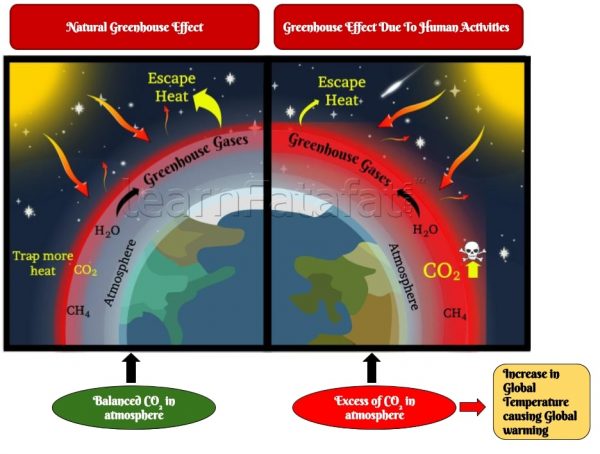
Greenhouse gases have the ability to trap heat energy emitted by sun and maintain temperature of earth. Carbon dioxide is one the greenhouse gases. Due to human activities there is increase in percentage of carbon dioxide in atmosphere. Hence, large amount of heat gets trapped in atmosphere causing increase in global temperature resulting in global warming. Such effect of greenhouse gas is called as greenhouse effect. - Oxygen Cycle:
- Combustion: Burning of substance in presence of atmospheric oxygen releases carbon dioxide.
- Respiration: Animal use atmospheric oxygen to breath and produce carbon dioxide.
- Decomposition: Plants and animal die and release carbon dioxide, oxygen and nitrogen in atmosphere.
- Photosynthesis: Plants use atmospheric carbon dioxide and oxygen is released out of plant body as a waste product.
- Ozone Layer:
Stratosphere contain a separate layer of ozone called as ozone layer. This layer protect living organisms from harmful ultraviolet rays emitted by sun. Due to various human activities, there is release of compound chlorofluorocarbons i.e. CFC’s in the air. These are stable compounds. After reaching to ozone layer they form compound with oxygen present in ozone. This causes reduction in ozone molecules causing depletion. If depletion of ozone layer continues human life may suffer from various diseases, e.g skin cancer.
Textbook simplified in Videos