- Matter: Any substance having mass and occupies space is called as matter.
- Particle of matter: Particles of matter are very small invisible to naked eye.
- Properties of particles of matter:
- Particles of matter have space between them. For example: sugar dissolved in water
- Particles of matter are in continuous motion. For example: mixing of ink in water
- Particles of matter are held by forces of attraction. For example: particle of brick is held by force of attraction, therefore, it is hard to break.
- States of matter: There are three states of matter solid, liquid and gases
- Diffusion in states of matter: Diffusion is intermixing of substances or matter with each other.
- Rate of diffusion of liquids is high as compared to solids.
- Rate of diffusion of gas into a gas is fastest.
- Pressure exerted by gas: Particle in gaseous phase moves high speed and collides with walls of container by exerting force on walls. Pressure is force exerted by gas particles per unit area on walls of container.
- Change in state of matter: It depends on factor like change in temperature and change in pressure.
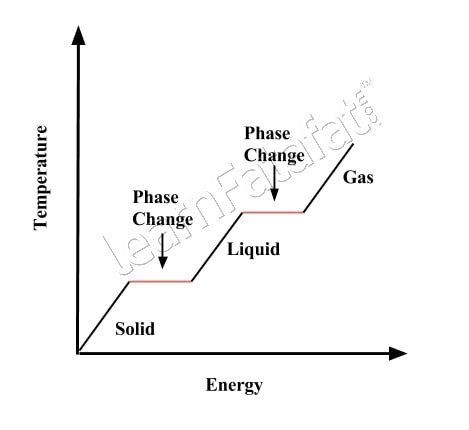
- Effect of change in temperature on state of matter: With increase in temperature kinetic energy of particles in matter increases. This breaks the force of attraction between the particles and particles starts moving freely and performs motion. When particle of solid undergo motion, solid gets converted to liquid state. When particle of liquid undergo motion, liquid is converted to gaseous state. Click here to watch the video on Change In States Of Matter
- Melting point: At atmospheric pressure, the temperature at which solid melts to form liquid is called as melting point of solid.
- Boiling point: At atmospheric pressure, the temperature at which liquid boils and turns into vapors is called as boiling point of liquid.
- Latent heat of fusion: At atmospheric pressure, the amount of heat required to convert one kilograms of solid to liquid at its melting point is called latent heat of fusion.
- Latent heat of evaporation: At atmospheric pressure, amount of heat required to change the unit mass of liquid into vapors at its boiling point is called latent heat of evaporation.
- Effect of change in pressure on states of matter: At low temperature, if pressure of on gas is reduced, then gas converts into liquid. With further increase in pressure liquid gets converted to solid state. Click here to watch video on Effects Of Change In Pressure On States Of Matter And Evaporation
- Sublimation: Process in which solid state directly convert to gaseous state without undergoing liquid state is called as sublimation.
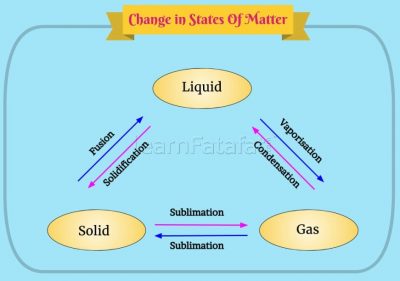
- Evaporation: Phenomenon of change of liquid into vapors at any temperature below its boiling point is called as evaporation.
- Factors affecting evaporation:
- Surface area: Rate of evaporation increase with increase in surface area and vice versa.
- Temperature: Rate of evaporation increases with increase in temperature and vice versa.
- Humidity: Rate of evaporation decreases with increase in humidity and vice versa.
- Wind speed: Rate of evaporation increases with increase in wind speed and vice versa.
- Evaporation and cooling: Liquids use heat energy from surrounding to convert from liquid to vapor state. This, decreases heat from surrounding and surrounding becomes cooler.
| Properties | Solid | Liquid | Gas |
|---|---|---|---|
| Shape | Definite shape | No definite shape | No definite shape |
| Volume | Fixed volume | Fixed volume | No fixed volume |
| Space | No vacant spaces between particles | Have small vacant spaces between particles | Have large spaces between the particles |
| Compressibility | Less compressible | More compressible than solids | Highly compressible |
| Rigidity | Possess rigidity | Not rigid | Not rigid |