- We require food for living. With increasing population, food requirements are also increasing. Hence, there is necessity of higher crop yields. Therefore, various steps are used to improve crop yield they are crop variety improvement, crop production improvement, crop protection management. Also, proper growth depends on climatic conditions, temperature, photoperiod [sunlight].
- Crops and season:
Season Month Crop Kharif June to October Paddy, soybean, pigeonpea, maize, cotton, green gram, black gram,etc Rabi November to April Wheat, gram, peas, mustard, linseed,etc - Crop yield improvements:
- Hybridisation technology: Plants are crossed to obtain desired characteristics. Crossing is done by intervarietal crossing – between plants of different variety, interspecific crossing – between plants of different species and genus, intergeneric crossing – between plants of different genus.
- Genetic improvements: Insertion of gene with desired characteristic into the plants.
- Factors on which improvement depends:
- Higher yield
- Improved quality: Rich in nutrients like carbohydrates, proteins, vitamins, etc.
- Biotic and abiotic resistance: Crop must be protected from diseases, insects, drought heat, cold, etc.
- Maturity duration: Same crop can be planted and harvested again and again in small interval of time.
- Wider adaptability: Crops growing in different climatic conditions and different areas can increase productivity.
- Desirable agronomic characteristics (Agronomic characters – tall or short): Crops with agronomic characters like tallness or shortness increases productivity. E.g. Tall crops are used as fodder crops.
- Crop Production Management: High production can be achieved if soil is rich in nutrients, necessary amount of water is supplied to crops [Irrigation] and with planned cropping pattern.
- Nutrient Management:
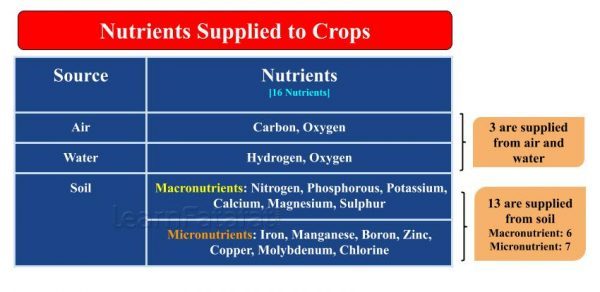
- If soil undergo decrease in these nutrients, production of crops gets affected. Hence, to increase production nutrients must be provided externally. This done by using manures and fertilizers.
- Manure: Made of organic substances like waste material of plants and animals, decayed animals, etc.
- Importance of manure: Increases fertility of soil, increases water holding capacity of sandy soil, avoid waterlogging in clayey soil.
- Types of manure:
Compost Vermicompost Green Manure - Animal waste, plant waste are kept for long time in pit
- These waste decompose and forms manure
- Process is called composting
- Compositing is carried at faster rate by adding earthworms
- Earthworms eats up the waste materials and throws out the waste from their body
- This waste is used as manure
- Process is called vermicomposting
- Plants like sun hemp, gaur planted in fields before sowing
- These are later spread in fields which acts as green manure
- Green manure are rich in nutrients like nitrogen and phosphorous
- Fertilizers: Chemically produced nutrients of crops. Fertilizers are responsible for high yield of crops. Excess use of fertilizer can decrease fertility of soil and enhance water pollution.
- Manure vs Fertilizer:
Manure Fertilizer Made from natural substances like animal waste, plant waste, etc Made from chemical compounds Plants absorbs nutrients from manure slowly Plants absorbs nutrients from fertilizers quickly Yield of crop is increased to small extent Yield of crop is high Do not cause water or soil pollution Causes water and soil pollution
- Irrigation: It is technique through which water is supplied to the crops.
- Wells: Water from dug wells and tube wells are taken out with the help of pumps are passed to fields for irrigation.
- Canals: Canals receives water from river. Canal is then branched to supply water to the fields.
- River lift system: This is used in areas where canals cannot be constructed. In this technique water from rivers are directly supplied to fields.
- Tanks: Tanks are small water storage system in which water is stored and utilised for irrigation.
- Cropping Pattern:
- Mixed cropping: Two or more crop are grown together. E.g. wheat and gram, groundnut and sunflower, etc.
- Intercropping: Modern type of mixed cropping in which few rows of one crop is planted following few rows of another type of crop. E.g. soyabean and maize, soyabean and wheat, etc.
- Advantage of intercropping: If one crop fails another one provides yield thereby, preventing heavy loss. Disease from one crop is not carried to another crop.
- Crop rotation: Different crop are grown in same field one after the other. This maintain the balance of nutrients in the soil.
- Crop protection management:
- Weeds: Weeds are unwanted plants which takes up essential nutrients from soil, hence, crops gets less amount of nutrient from the soil. Weeds can be removed by manual method, by deep ploughing,etc.
- Insects and pests: Insects and pests damage crops by cutting leaves, stems and roots, by sucking cell sap [fluid present in vacuole]. Spraying chemicals like insecticides and pesticides kills them, thereby, increasing the productivity.
- Disease: Diseases are caused in plants due to bacteria, fungi and viruses. Plants can be protected by diseases due to use of herbicides, fungicides, etc.
- Storage of grains:
- Storage of food grain is important for future needs.
- Stored grains gets damaged by rodents, insects, excess of moisture.
- To avoid loss, storage godowns must be cleaned properly, chemicals must be sprayed, grains must be properly dried in sunlight and prevented from moisture.
- Animal husbandry: Branch of agriculture which deal with management of animal livestock where, animals are raised to obtain milk, eggs, etc from them. This includes cattle farming, poultry farming, fish production and beekeeping.
- Cattle farming: Cattle farming is done for milk production and agricultural work. Species of cattle in India are Bos indicus i.e. cows, Bos bubalis i.e. buffaloes, etc. Cattles producing milk are called milch animal. Cattle used for labor work are called as draught animals. Different breeds are crossed to obtain desired quality in calf.
Cattles Benefits Jersey, Brown Swiss [Foreign breeds] High milk production Red sindhi, Sahiwal [Indian breeds] High resistance to disease - Care and food for cattle:
- Maintenance of roof shade to prevent cattle from rain, heat and cold.
- Floors must be sloping to remove excess of water.
- Cattles must be brushed regularly. This removes dirt and loose hair from body.
- Food must include roughage with lots of fibres. Concentrates having high proteins. Vitamin and mineral rich food must be provided to increase milk production.
- Diseases:
- Cattle may suffer with internal or external parasites. Internal parasites like worms causes stomach and intestinal problem, whereas, flukes causes liver problem.
- Infectious disease are caused by bacteria and viruses which can be prevented by vaccination.
- Care and food for cattle:
- Poultry Farming: It is related to bird farming for production of egg and meat. They are categorized into layers and broilers. Layers are the birds raised for production of eggs. Broilers are the birds raised for production of meat. Crossing is done to acquire desired properties like quality of chickens, dwarf broiler for commercial production, ability to tolerate high temperature, low maintenance requirement, etc.
- Egg and broiler production: Few practices are followed to increase the production of birds.
- Food: Layers require fibrous food. Broiler require high vitamin i.e. vitamin A and K, proteins and fat rich food.
- Care and hygiene: Proper care must be taken to avoid death of birds, to maintain feathering. Temperature and cleanliness of farm must be maintained.
- Protection of diseases: Birds can be catch disease due to viruses or bacterias. To prevent birds from disease it is necessary to spray disinfectants in the farm. Also, birds should be vaccinated.
- Egg and broiler production: Few practices are followed to increase the production of birds.
- Fish Production: Fish are rich in proteins hence are used as food. Fishes are obtained from capture fishing or culture fishery. Capture fishing is done in natural resource like sea, river, etc. culture fisheries is done in manmade resources like lakes and ponds.
- Marine Fishery: Fishing is done in sea with help of net which includes fishes like pomfret, mackerel, sardines, bombay duck, etc. Marine fishes like mullets, bhetki, prawns, oysters, etc, are farmed due to high economic value. Mariculture is the process, in which fishes are farmed in sea water by making ponds.
- Inland Fishery: Fishery done in freshwater like river, ponds, lakes, etc. it is also done in brackish water [Brackish water is place where seawater and freshwater meets.]. Inland fishing allows both capture fishing and culture fishing.
- Composite fish culture is a method in which fishes are different variety are farmed in a single pond on basis of their food habitat. Catlas are surface feeders, Rohus feeds on middle zone, whereas, mrigal and common carps are bottom feeders. Grass carps feeds on the weeds inside water. Therefore, all the food inside the pond is used up.
- Problem with this method is that fish production is at slower rate as fish lay eggs only in monsoon. Hence, fishes are provided with hormonal stimulation, so that they can reproduce any time. This increases quantity of fishes.
- Beekeeping: Bee is raised for production of honey and wax. Bees are raised in bee farms or apiaries. Variety of bees( Apis cerana indica– Indian bee, Apis dorsata – rock bee and Apis florae – little bee, Apis mellifera – an Italian bee) are used for honey production out of which italian bee gives high yield of honey. Quality and taste of honey depends on variety of flowers for nectar and pollen.
Textbook simplified in Videos