- Atom: Smallest particle of matter
- Law of chemical combination:
- Law of conservation of mass: In a chemical reaction, mass can neither be created nor be destroyed.
- Law of constant proportions: In a chemical substance, all elements are present in definite proportion.
- Postulates of Dalton’s Atomic Theory:
- Matter is made up of small indivisible particles called atoms
- Atoms are neither created nor destroyed, they are rearranged during the chemical reaction.
- Atoms of same element have same mass, size and chemical properties.
- Atoms of different element have different mass, size and chemical properties.
- Atoms combines in whole number ratio to form compound.
- Relative number and kind of atoms are constant in compounds.
- Symbolic representation of elements:
- Dalton’s Representation: Symbols consist of circles containing, letter or different signs.
- Berzelius Representation: Symbols contains, first one or two letters from the name of element.
- Nomenclature:
- Name of element derived from place of occurrence or from color of element.
- IUPAC approves the derived name.
- For symbols, first letter is in uppercase and second letter is in lowercase.
- Symbols are also derived from greek and latin names of elements.
- Atomic mass: Mass of specific atom.
- Atomic mass unit: A mass unit exactly equal to one-twelfth (1 / 12th) mass of one atom of carbon – 12 isotope (12C). It is denoted by amu or u.
- Relative atomic mass unit: Average mass of the atom, compared to 1/12th mass of one carbon-12 atom.
- Molecule: Two or more atoms chemically combine with each other by attractive forces and forms molecule.
- Molecules of elements: Contains atoms of similar type.
- Atomicity: It is number of atoms in a molecule
- Molecules of compounds: Atoms of different elements are joined in different proportions.
- Chemical Formula: It is a symbolic representation of chemical compound.
- Valency: Capacity of element to combine with other element.
- Rules for writing chemical formula for binary compound:
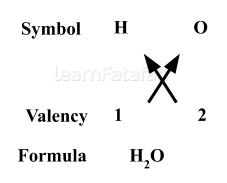
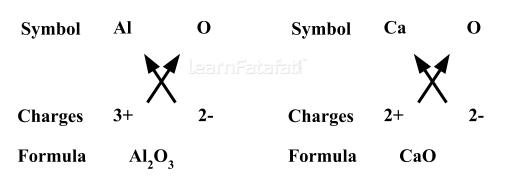
- For binary compounds: Write elements and their valencies, crossover the valency and write it as a subscript.
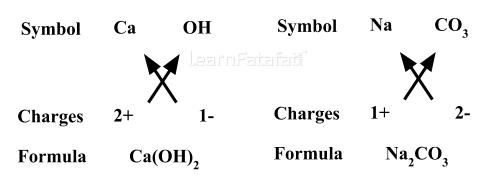
- For ionic compounds: Write cation before anion, crossover the charges and write it as a subscript. If charges are same neglect the subscript.
- For more than one similar group: Arrange elements or ions, crossover their valency or charges, include ions occurring twice in brackets. If only one ion is present, neglect the brackets.
- Molecular mass: It is sum of atomic masses of all atoms in a molecule.
- Unit of molecular mass: atomic mass unit (u)
- Example: Molecular mass of water = ( 2 × Atomic mass of hydrogen) + Atomic mass of oxygen = (2 × 1 u ) + 16 u= 2 u + 16 u= 18 u
- Formula unit mass: It is the sum of masses of all atoms in formula unit or ions of given compound.
- Unit of formula unit mass: atomic mass unit (u)
- Example: Formula unit mass of NaCl = Atomic mass of Na+ + Atomic mass of Cl- = 1 × 22.9u + 1 × 35.45u= 22.9u + 35.45u= 58.35 u
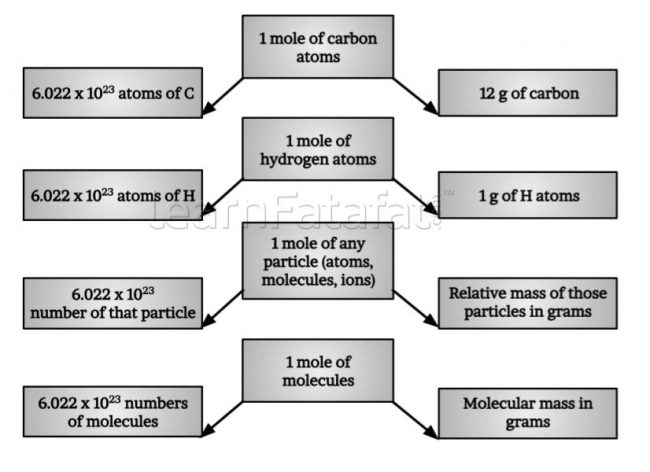
- One mole of substance: An amount of substance containing same number of particles, as that of atoms in 12g of carbon-12 isotopes. Particles can be atoms or molecules or ions. One mole of substance contains 6.022 × 10²³ particles.
- Avogadro’s Number: One mole of substance contains 6.022 × 10²³ particles. This number is called Avogadro’s Number denoted by NA.
- Molar Mass: Mass of one mole of substance
- Relationship between Mole, Avogadro’s Number and Mass:
| Name of element | Atomicity | Number of atoms |
|---|---|---|
| Argon | Monoatomic | One |
| Sodium | Monoatomic | One |
| Nitrogen | Diatomic | Two |
| Hydrogen | Diatomic | Two |
| Phosphorous | Tetraatomic | Four |
| Compound | combining elements | ratio by mass |
|---|---|---|
| Water | Hydrogen, Oxygen | 1:8 |
| Ammonia | Nitrogen, Hydrogen | 14:3 |
| Carbon Dioxide | Carbon, Oxygen | 3:8 |