NCERT Solutions for Class 9 Science
Chapter 2 Is Matter Around Us Pure?
NCERT Solution for Class 9 Maths and Science (Free). LearnFatafat has created free NCERT Solutions for Class 9 Science Chapter 2 Is Matter Around Us Pure? In this Chapter 2 Is Matter Around Us Pure?, you will learn Mixture, Concentration of solution and Suspension, Colloidal Solution, Separating the components of a mixture, Separation of components from mixture: Physical and Chemical changes, Types of Pure Substances. This class 9 Science Chapter 2 Is Matter Around Us Pure? course is consists of Notes, M.C.Q’s, Videos and Free NCERT Solutions.
NCERT Solutions for Class 9 Science Chapter 2 Is Matter Around Us Pure?
1. Which separation techniques will you apply for the separation of the following?
(a) Sodium chloride from its solution in water.
Answer: Sodium chloride from its solution in water is separated by method of evaporation.
(b) Ammonium chloride from a mixture containing sodium chloride and ammonium chloride.
Answer: Ammonium chloride is sublimable. Therefore, ammonium chloride is separated by the method of sublimation.
(c) Small pieces of metal in the engine oil of a car.
Answer: This can be done by the process of filtration.
(d) Different pigments from an extract of flower petals.
Answer: It can be separated by the process of chromatography.
(e) Butter from curd.
Answer: Butter from the curd is separated by centrifugation method.
(f) Oil from water.
Answer: Oil and water can be separated by separating funnel.
(g) Tea leaves from tea.
Answer: Tea leaves can be separated from tea through filtration.
(h) Iron pins from sand.
Answer: This can be separated with magnetic separation.
(i) Wheat grains from husk.
Answer: This can be separated by winnowing.
(j) Fine mud particles suspended in water.
Answer: This can be separated by sedimentation process.
2. Write the steps you would use for making tea. Use the words solution, solvent, solute, dissolve, soluble, insoluble, filtrate and residue.
Answer:
- Take a cup of milk into the vessel. Cup of milk acts as a solvent. Now heat milk .
- Add tea leaves which acts as a solute with continuous heating.
- Add sugar and stir it to dissolve easily.
- Sugar is another solute that is soluble in solvent.
- Now filter this solution using a strainer. After filtration tea leave are left behind as residue. Sugar and other soluble components passes through the strainer and gets collected as a filtrate.
3. Pragya tested the solubility of three different substances at different temperatures and collected the data as given below (results are given in the following table, as grams of substance dissolved in 100 grams of water to form a saturated solution).
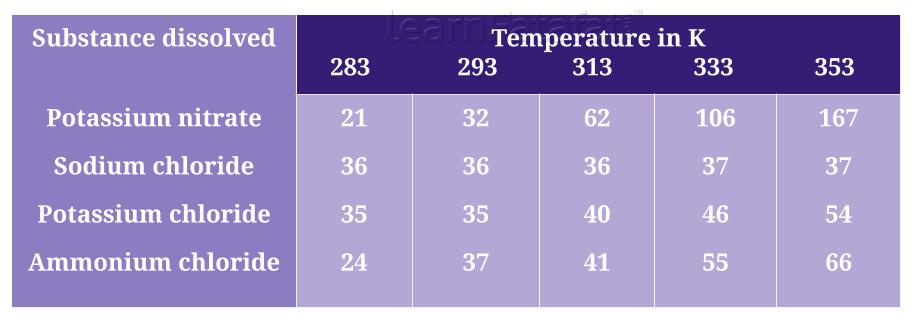
(a) What mass of potassium nitrate would be needed to produce a saturated solution of potassium nitrate in 50 grams of water at 313 K?
Answer: Given: mass of potassium nitrate to get its saturated solution in 100g of water at temperature 313 K is 62 g.
Mass of potassium nitrate to get its saturated solution in 50 g of water = ?
∴ Required amount = ( 62 x 50 ) / 100 = 31
Thus, 31g of potassium nitrate is required to get its saturated solution in 50 g of water.
(b) Pragya makes a saturated solution of potassium chloride in water at 353 K and leaves the solution to cool at room temperature. What would she observe as the solution cools? Explain.
Answer: While cooling of solution precipitate of crystals of potassium chloride is observed.
(c) Find the solubility of each salt at 293 K. Which salt has the highest solubility at this temperature?
Answer: Solubility of salt at 293 k is given as follows-
- Potassium nitrate = 32
- Sodium chloride = 36
- Potassium chloride = 35
- Ammonium chloride = 37
At this temperature ammonium chloride has highest solubility.
(d) What is the effect of change of temperature on the solubility of a salt?
Answer: Solubility increases with increase in temperature and decrease with decrease in temperature. In a solution, if salt dissolved reaches to its saturation point, then by increasing its temperature, more amount of salt can be dissolved by increasing the temperature of solution.
4. Explain the following giving examples.
(a) saturated solution
(b) pure substance
(c) colloid
(d) suspension
Answer:
(a) Saturated solution: For a given temperature, if no more solute can be dissolved in a solution then it is said to be saturated solution.
(b) Pure substance: Presence of only one type of atom, compound or molecule without any other particles is called pure substance. For example – sugar, salt, etc.
(c) Colloid: Colloid is a heterogeneous mixture. Collide particles are small which are not visible to naked eye. Moreover, these are evenly distributed in the solution. Colloids do not settle if solution is kept undisturbed. They cannot be separated by the process of filtration. Tyndall effect can be observed in colloidal solution. For example – milk.
(d) Suspension: It is a heterogeneous mixture in which particle of solute do not dissolve and remain suspended within the solution. Particles of suspension are visible to naked eye. Suspensions shows tyndall effect. Particles in suspension settles down when kept undisturbed and can be separated by the method of filtration.
5. Classify each of the following as a homogeneous or heterogeneous mixture. soda water, wood, air, soil, vinegar, filtered tea.
Answer:
Homogeneous mixture – soda water, vinegar, filtered tea
Heterogeneous mixture – wood, air, soil
6. How would you confirm that a colourless liquid given to you is pure water?
Answer: It is known that boiling point of water is 100 °C. Boil the given liquid till 100 °C. If it starts boiling then liquid is pure water, else it is not pure water.
7. Which of the following materials fall in the category of a “pure substance”?
(a) Ice
(b) Milk
(c) Iron
(d) Hydrochloric acid
(e) Calcium oxide
(f) Mercury
(g) Brick
(h) Wood
(i) Air
Answer: Pure substances are – ice, iron, hydrochloric acid, mercury, calcium oxide.
8. Identify the solutions among the following mixtures.
(a) Soil
(b) Sea water
(c) Air
(d) Coal
(e) Soda water
Answer: Solutions from given mixtures are sea water, air and soda water.
9. Which of the following will show “Tyndall effect”?
(a) Salt solution
(b) Milk
(c) Copper sulphate solution
(d) Starch solution
Answer: Milk and starch solution shows tyndall effect from the given solutions.
10. Classify the following into elements, compounds and mixtures.
(a) Sodium
(b) Soil
(c) Sugar solution
(d) Silver
(e) Calcium carbonate
(f) Tin
(g) Silicon
(h) Coal
(i) Air
(j) Soap
(k) Methane
(l) Carbon dioxide
(m) Blood
Answer:
| Elements | Compounds | Mixtures |
|---|---|---|
| Sodium, Silver, Tin, Silicon | Calcium carbonate, Soap, Methane, Carbon dioxide | Soil, Solution, Coal, Air, Blood. |
11. Which of the following are chemical changes?
(a) Growth of a plant
(b) Rusting of iron
(c) Mixing of iron filings and sand
(d) Cooking of food
(e) Digestion of food
(f) Freezing of water
(g) Burning of a candle.
Answer: Following are the chemical changes – (a) Growth of a plant (b) Rusting of iron (d) Cooking of food (e) Digestion of food (g) Burning of a candle.
Check other lessons NCERT Solutions for Class 9
Download free NCERT textbook class 9 Science – Chapter 2 Is Matter Around Us Pure?
CBSE Class 9
Access Class 9 video lessons online (internet required) or offline(internet not required) in SD Card, Pendrive, DVD, Tablet.
Chapter 2 – Is Matter Around Us Pure?