

NCERT Solutions for Class 7 Science
Chapter 14 Electric Current and its Effects
LearnFatafat offers free NCERT Solutions for Class 7 Science Chapter 14 Electric Current and its Effects. Chapter covers the topics like symbols of electrical components, heating effect of electric current, magnetic effect of electric current, electromagnet, electric bell and more. Check video lessons for Class 7 Science Chapter 14 Electric Current and its Effects click here to buy.
NCERT Solutions for Class 7 Science Chapter 14 Electric Current and its Effects
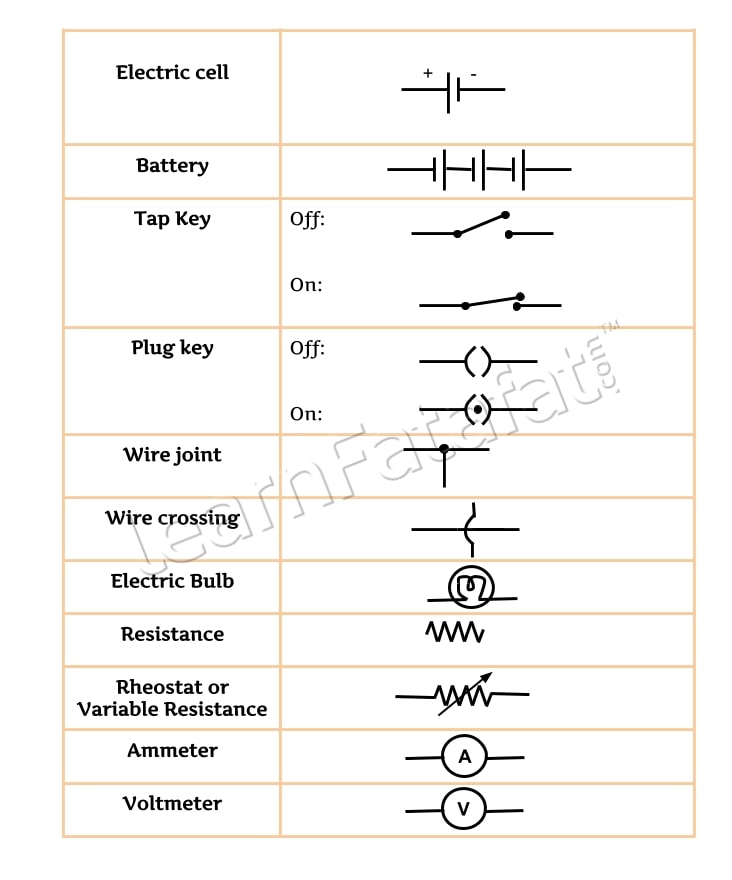
1. Draw in your notebook the symbols to represent the following components of electrical circuits: connecting wires, switch in the ‘OFF’position, bulb, cell, switch in the ‘ON’ position, and battery
Answer:
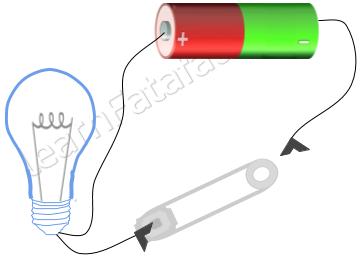
2. Draw the circuit diagram to represent the circuit shown in Fig.
Answer: For given figure, circuit diagram can be drawn as follows.
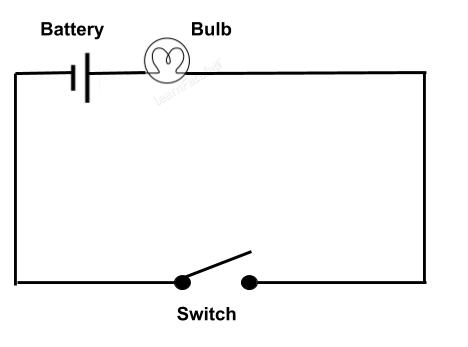
Here, one terminal of bulb is connected to cell and other terminal is connected to safety pin. In figure, it can be seen that, other end of safety pin is not connected to other drawing pin, this suggest that circuit is incomplete. Therefore, safety pin shows that switch is in off position.
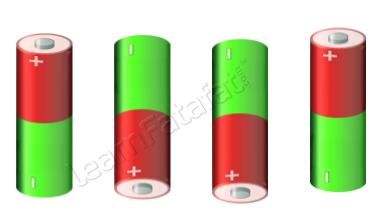
3. Fig. shows four cells fixed on a board. Draw lines to indicate how you will connect their terminals with wires to make a battery of four cells.
Answer:
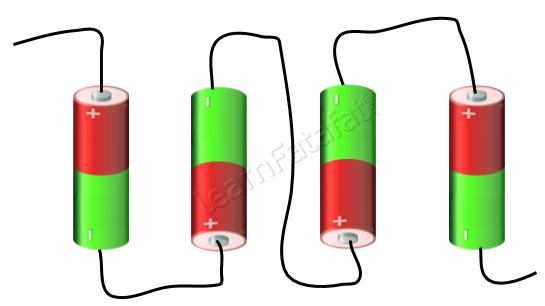
Given arrangement can be made to make a battery of four cells. Here, battery is made by connecting negative terminal of one cell to positive terminal of next cell and so on.
4. The bulb in the circuit shown in Fig. does not glow. Can you identify the problem? Make necessary changes in the circuit to make the bulb glow.
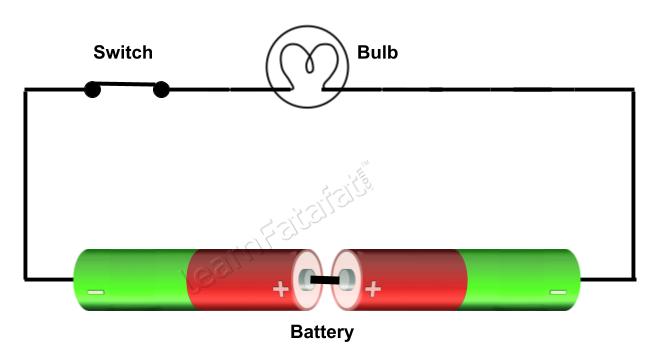
Answer:

In the given circuit, positive terminal of both cells are connected to each other. Thus, bulb in the circuit does not glow. To make bulb glow, negative terminal of one cell should be connected to positive terminal of other cell.
5. Name any two effects of electric current.
Answer: Two effects of an electric current are –
1) Heating effect of electric current
2) Magnetic effect of electric current
6. When the current is switched on through a wire, a compass needle kept nearby gets deflected from its north-south position. Explain.
Answer: When current passes through wire, due to magnetic effect of electric current, current carrying wire acts as a magnets. Thus, when compass needle is kept near the wire it gets deflected from its north south position.
7. Will the compass needle show deflection when the switch in the circuit shown by Figure is closed?
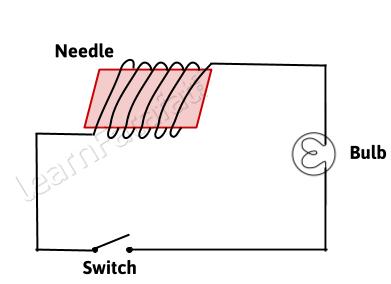
Answer: If switch is closed, then compass needle will show no deflection. This is because, there is no current passing through the circuit, and so wire will not act as a magnet, thus no deflection will occur in compass needle.
8. Fill in the blanks:
(a) Longer line in the symbol for a cell represents its ________ terminal.
Answer: positive
(b) The combination of two or more cells is called a ________ .
Answer: battery
(c) When current is switched ‘on’ in a room heater, it ________ .
Answer: generates heat
(d) The safety device based on the heating effect of electric current is
9. Mark ‘T’ if the statement is true and ‘F’ if it is false:
(a) To make a battery of two cells, the negative terminal of one cell is connected to the negative terminal of the other cell. (T/F)
Answer: True
(b) When the electric current through the fuse exceeds a certain limit, the fuse wire melts and breaks. (T/F)
Answer: True
(c) An electromagnet does not attract a piece of iron. (T/F)
Answer: False. [ An electromagnet acts as a magnet when current is passed through it. Thus it will attract iron pieces. ]
(d) An electric bell has an electromagnet. (T/F)
Answer: True
10. Do you think an electromagnet can be used for separating plastic bags from a garbage heap? Explain.
Answer: Plastic bags are non magnetic material. Electromagnet can separate magnetic materials from the garbage. Thus, electromagnet will not be helpful in separating plastic bags from garbage heap.
11. An electrician is carrying out some repairs in your house. He wants to replace a fuse by a piece of wire. Would you agree? Give reasons for your response.
Answer: No, one must not agree for this. It’s because, fuse wire has very low melting point, in case, the current exceeds it melts and breaks the circuit, thereby, preventing overloading of current and fire. If electrician replaces the fuse with ordinary wire, then during current overloading wire will not melt and excess of current will cause short circuit or even fire.
12. Zubeda made an electric circuit using a cell holder shown in Figure, a switch and a bulb. When she put the switch in the ‘ON’ position, the bulb did not glow. Help Zubeda in identifying the possible defects in the circuit.
Answer: Defects in the circuit could be-
- Connection must be loose. Check connections
- Terminals should be connected properly i.e. negative terminal should be connected to positive terminal of other battery.
- Check if cells are in proper contact, else bulb will not glow.
13. In the circuit shown in Figure:
(i) Would any of the bulb glow when the switch is in the ‘OFF’ position?
(ii) What will be the order in which the bulbs A, B and C will glow when the switch is moved to the ‘ON’ position?
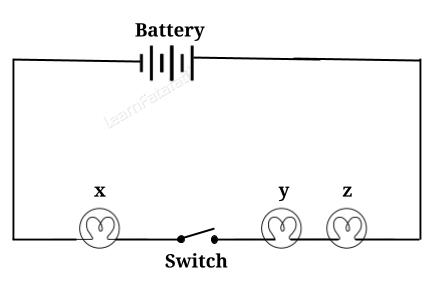
Answer:
- No bulb will glow if switch is in OFF position – This is because current will not pass through the circuit when switch is in OFF position
- All bulbs will glow simultaneously – When switch is turned ON all bulb will glow at the same time as they are connected to same battery
Check other lessons NCERT Solutions for Class 7
Download free NCERT textbook class 7 Science – Chapter 14 Electric Current and its Effects
CBSE Class 7
Access Class 7 video lessons online (internet required) or offline(internet not required) in SD Card, Pendrive, DVD, Tablet.
Chapter 14 – Electric Current and its Effects


