

NCERT Solutions for Class 8 Science
Chapter 8 Cell Structure and Functions
LearnFatafat offers free NCERT Solutions for Class 8 Science Chapter 8 Cell – Structure and Functions. Chapter covers the topics like what is cell, variety of cell number, shape and size, components of cell, comparison of animal cell and plant cell and more. Check video lessons and MCQ quizzes for Class 8 Science Chapter 8 Cell – Structure and Functions click here to buy.
NCERT Solutions for Class 8 Science Chapter 8 Cell Structure and Functions
1. Indicate whether the following statements are True (T) or False (F).
(a) Unicellular organisms have one-celled body.
Answer: True (T)
(b) Muscle cells are branched.
Answer: False (F). [ Muscle cells are spindle shaped ]
(c) The basic living unit of an organism is an organ.
Answer: False (F). [ The basic living unit of an organism is cell. ]
(d) Amoeba has irregular shape.
Answer: True (T)
2. Make a sketch of the human nerve cell. What function do nerve cells perform?.
Answer:

3. Write short notes on the following.
(a) Cytoplasm
Answer: Cytoplasm is a fluid present in between plasma membrane and nucleus of cell. Mitochondria, golgi complex and other cell organelles are suspended in cytoplasm. Cytoplasm is responsible for exchange of materials between different cell organelles within the cells.
(b) Nucleus of a cell
Answer: A nucleus is covered with double layer membrane called as nuclear membrane. It contains pores which allow the transport of material outside the nucleus. Nucleus contains rod shaped structures, called chromosomes. Chromosomes contains highly condensed structure called Deoxyribonucleic Acid i.e DNA, and proteins. Interesting fact to know about DNA is that, if DNA is straighten along the line, its length will be approximately 2 meters long, also, DNA is responsible in passing the properties from parents to children. The functional segments in DNA are called as genes. In case, when cell is not divisible, DNA is present in form of chromatin. When the cell is ready to divide, chromatin forms chromosome. Nucleus plays an important role in process of reproduction. During reproduction, a single cell divides and re-divides to form complex bodies.
4. Which part of the cell contains organelles?
Answer: Cytoplasm is a fluid present between plasma membrane and nucleus of cell. Cytoplasm contains cell organelles like mitochondria, golgi complex, endoplasmic reticulum, etc.
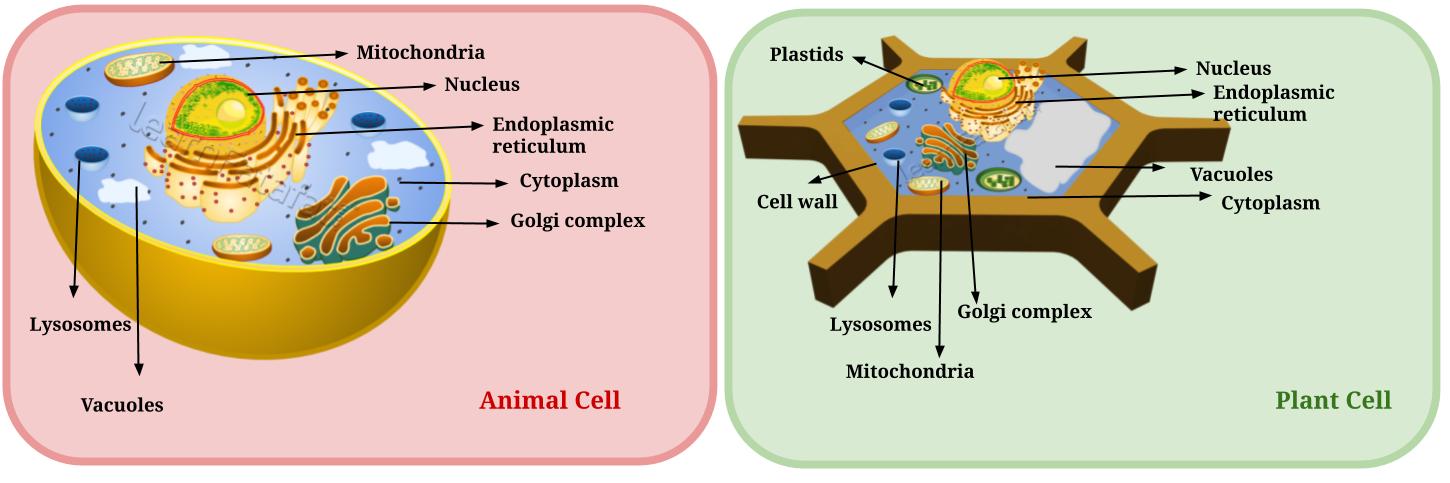
5. Make sketches of animal and plant cells. State three differences between them.
Answer:
| Animal cell | Plants cell |
|---|---|
| Cell wall is not present | Cell wall is present |
| Vacuoles is small in size | Vacuole is comparatively larger than animal cell |
| Plastids are absent | Plastids are present |
| Have different shapes of cells | In general, shape of cells are fixed |
| Nucleus is present at center of the cell | Nucleus is present towards one side of the cell |
6. State the difference between eukaryotes and prokaryotes.
Answer:
| Prokaryotic Cell | Eukaryotic Cell |
|---|---|
| Nucleus is absent | Nucleus is present |
| Do not contain membrane bound organelles | Contains membrane bound organelles |
| Are mostly unicellular | Are multicellular |
| E.g. E.coli, Streptococcus,etc. | E.g. Plants, animals, etc. |
7. Where are chromosomes found in a cell? State their function.
Answer: Nucleus contains rod shaped structures, called chromosomes. Chromosomes contains highly condensed structure called Deoxyribonucleic Acid i.e DNA, and proteins. DNA is responsible in passing the characteristics from parents to children. The functional segments in DNA are called as genes.
8. ‘Cells are the basic structural units of living organisms’.Explain.
Answer: Cells are called basic structural unit of living organism because cell is smallest unit of life which can perform all living functions. Cells have various shape and sizes according to its functions.
9. Explain why chloroplasts are found only in plant cells?
Answer: Chloroplast contain green colored pigment called chlorophyll. Chlorophyll is needed for the process of photosynthesis in plants. It has ability to traps sunlight and use it for the preparation of food for plants.
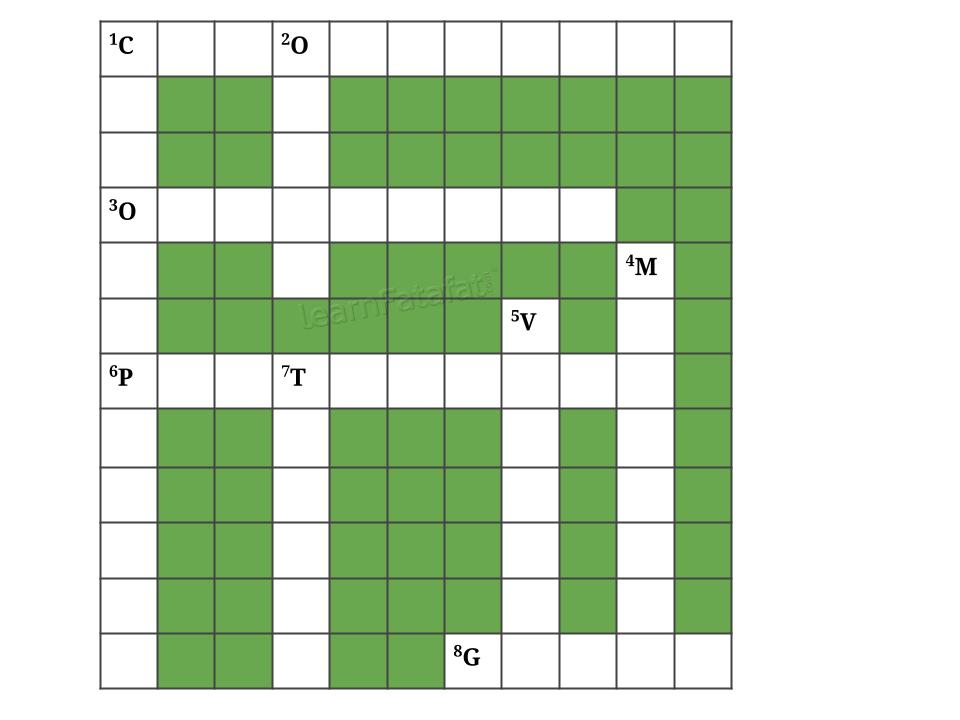
10. Complete the crossword with the help of clues given below.
Across : 1. This is necessary for photosynthesis 3. Term for component present in the cytoplasm. 6. The living substance in the cell. 8. Units of inheritance present on the chromosomes.
Down : 1. Green plastids. 2. Formed by collection of tissues. 4. It separates the contents of the cell from the surrounding medium. 5. Empty structure in the cytoplasm. 7. A group of cells
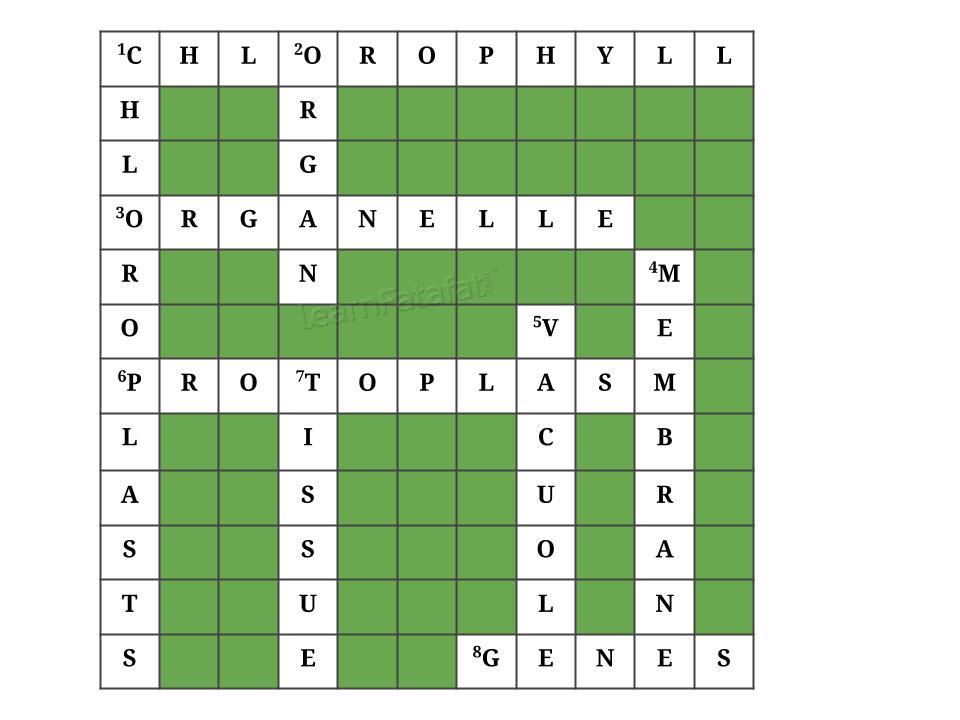
Answer:
Across 1. Chlorophyll 3. Organelle. 6. Protoplasm 8.Genes
Down 1. Chloroplasts 2. Organ 4. Membrane 5. Vacuole 7. Tissue
Check other lessons NCERT Solutions for Class 8
Download free NCERT textbook class 8 Science – Chapter 8 Cell Structure and Functions
CBSE Class 8
Access Class 8 video lessons online (internet required) or offline(internet not required) in SD Card, Pendrive, DVD, Tablet.
Chapter 8 – Cell Structure and Functions