

NCERT Solutions for Class 8 Science
Chapter 3 Synthetic Fibres and Plastics
LearnFatafat offers free NCERT Solutions for Class 8 Science Chapter 3 Synthetic Fibres and Plastics. Chapter covers the topics like synthetic fibres and their properties, types of synthetic fibres, plastics and its useful properties, plastic and the environment and more. Check video lessons, notes and MCQ quizzes for Class 8 Science Chapter 3 Synthetic Fibres and Plastics click here to buy.
NCERT Solutions for Class 8 Science Chapter 3 Synthetic Fibres and Plastics
1. Explain why some fibres are called synthetic.
Answer: Manmade fibres, prepared from chemicals are called synthetic fibres. These are made by joining small units together to form long chain. Some synthetic fibres are rayon, nylon, polyester, etc.
2. Mark the correct answer. Rayon is different from synthetic fibres because
(a) it has a silk-like appearance.
(b) it is obtained from wood pulp.
(c) its fibres can also be woven like those of natural fibres.
Answer: (b) it is obtained from wood pulp
3. Fill in the blanks with appropriate words.
(a) Synthetic fibres are also called __________ or __________ fibres.
Answer: manmade, artificial
(b) Synthetic fibres are synthesised from raw material called __________ .
Answer: petrochemicals
(c) Like synthetic fibres, plastic is also a __________ .
Answer: polymer
4. Give examples which indicate that nylon fibres are very strong.
Answer: Nylon fibres are used to make parachutes, also, it is used to make climbing ropes. This shows that nylon has high tensile strength. Thus, nylon fibres are very strong.
5. Explain why plastic containers are favoured for storing food.
Answer: Plastic containers are favoured for storing food because plastics are lightweight, are available at lower price, have high strength and are easy to handle.
6. Explain the difference between thermoplastic and thermosetting plastics.
Answer:
| Thermoplastic | Thermosetting plastic |
|---|---|
| Can be bent easily. | Cannot be bent easily. |
| Softens easily when heated | Do not get soft when heated |
| Can be reshaped | Cannot be reshaped once moulded |
| Polythene, PVC, etc are made from thermoplastic | E.g. radio and television cabinets, kitchenware are made from thermosetting plastics |
7. Explain why the following are made of thermosetting plastics.
(a) Saucepan handles
(b) Electric plugs/switches/plug boards
Answer: a) Thermosetting plastics are bad conductor of heat. Thus, they donot get soft on heating. Therefore, they are used to make saucepan handles.
b) Bakelite is thermosetting plastic which is bad conductor of electricity. Thus, these are used to make electric plugs, switches and plugboards.
8. Categorise the materials of the following products into ‘can be recycled’ and ‘cannot be recycled’.
Telephone instruments, plastic toys, cooker handles, carry bags, ball point pens, plastic bowls, plastic covering on electrical wires, plastic chairs, electrical switches.
Answer:
| Recyclable | Non Recyclable |
|---|---|
| Plastic toys | Telephone instruments |
| Carry bags | Cooker handle |
| Ball point pens | Electrical switches |
| Plastic bowls | – |
| Plastic covering on wires | – |
| Plastic chairs | – |
9. Rana wants to buy shirts for summer. Should he buy cotton shirts or shirts made from synthetic material? Advise Rana, giving your reason.
Answer: Rana should buy cotton shirt, because cotton is good absorber, it will absorb sweat and allow it to evaporate in surrounding, thereby keeping the body cool.
10. Give examples to show that plastics are noncorrosive in nature.
Answer: Nature of plastic is non reactive thus, even if they come in contact with strong chemicals they do not react, thus nature of plastics are non corrosive. For example, cleaning chemicals at our homes are kept in plastic container rather than metal containers.
11. Should the handle and bristles of a tooth brush be made of the same material? Explain your answer.
Answer: No, both should of different materials. Handle should be made of hard material and bristles should be made of some soft material.
12. ‘Avoid plastics as far as possible’. Comment on this advice.
Answer: Plastics are non biodegradable material. They may or maynot decompose even after hundreds of year. Moreover, if plastics are burnt, they release in harmful gases in environment causing pollutions and diseases. If plastics are swallowed by animals, it can cause death. Thus, it is recommended to avoid plastics as far as possible.
13. Match the terms of column A correctly with the phrases given in column B.
| Column I | Column II |
|---|---|
| (i) Polyester | (a) Prepared by using wood pulp |
| (ii) Teflon | (b) Used for making parachutes and stockings |
| (iii) Rayon | (c) Used to make non-stick cookwares |
| (iv) Nylon | (d) Fabrics do not wrinkle easily |
Answer:
| Column I | Column II |
|---|---|
| (i) Polyester | (d) Fabrics do not wrinkle easily |
| (ii) Teflon | (c) Used to make non-stick cookwares |
| (iii) Rayon | (a) Prepared by using wood pulp |
| (iv) Nylon | (b) Used for making parachutes and stockings |
14. ‘Manufacturing synthetic fibres is actually helping conservation of forests’. Comment.
Answer: Manufacturing of synthetic fibres are carried using petrochemicals. If natural fibres are used then raw material are collected from plants. This involves cutting of plants. Thus, manufacturing of synthetic fibres actually helps in conservation of forests.
15. Describe an activity to show that thermoplastic is a poor conductor of electricity.
Answer: Connect a circuit as shown in figure using metal piece and piece of thermoplastic.
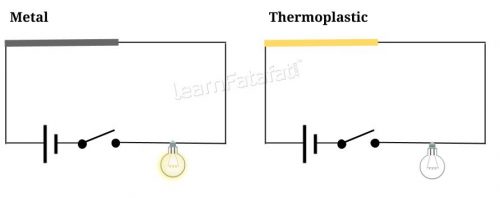
If you observe carefully bulb glows through the circuit connected with metal piece. Conversely, bulb does not glows in the circuit connect with piece of thermoplastic. This shows that, thermoplastic is poor conductor of electricity.
Check other lessons NCERT Solutions for Class 8
Download free NCERT textbook class 8 Science – Chapter 3 Synthetic Fibres and Plastics
CBSE Class 8
Access Class 8 video lessons online (internet required) or offline(internet not required) in SD Card, Pendrive, DVD, Tablet.
Chapter 3 – Synthetic Fibres and Plastics