

NCERT Solutions For Class 10 Science Chapter 12 Electricity
LearnFatafat offers free NCERT Solutions for Class 10 Science Chapter 12 Electricity. Chapter covers the topics like what is electricity, Ohm’s law, circuit diagrams, resistance, resistors in series and parallel, heating effect of electric current and more. Check video lessons, notes and MCQ quizzes for Class 10 Science Chapter 12 Electricity click here to buy.
NCERT Solutions for Class 10 Science Chapter 12 Electricity
1. A piece of wire of resistance R is cut into five equal parts. These parts are then connected in parallel. If the equivalent resistance of this combination is R′, then the ratio R/R′ is –
(a) 1/25 (b) 1/5 (c) 5 (d) 25
Answer: (d) 25
Solution: Resistance is proportional to length. Resistance of piece of wire is R. When wire is cut into five equal parts, resistance of each part becomes R/5. when all parts are connected in parallel combination their equivalent resistance becomes –
1/R’ = 1/R1 + 1/R2 + 1/R3 + 1/R4 + 1/R5
= 1 / (R/5) + 1 / (R/5) + 1 / (R/5) + 1 / (R/5) + 1 / (R/5)
= 5/R + 5/R + 5/R + 5/R + 5/R
= (5+5+5+5+5)/R
= 25 / R
R’ = R / 25
∴ R / R’ = 25
2. Which of the following terms does not represent electrical power in a circuit?
(a) I2R (b) IR2 (c) VI (d) V2/R
Answer: (b) IR2
Solution: Electrical power P = VI
We know that, Ohm’s law V = IR
Using above both equations,
P = (IR)I
P = I2R
Ohm’s law can be rearranged as I = V / R
∴ P = V x V/R
∴ P = V2/ R
∴ P = VI = I2R = V2 / R
3. An electric bulb is rated 220V and 100 W. When it is operated on 110V, the power consumed will be –
(a) 100 W (b) 75 W (c) 50 W (d) 25 W
Answer: (d) 25 W
Solution: Given Power P = 100 W
Voltage V = 220 V
Energy consumed P = V2/R
∴ R = V2/ P
∴ R = (220)2 / 100
= 48400 / 100
= 484 ohm
Resistance remains constant if supply of voltage is reduced to 110 V.
Energy consumed is given by P’ = (V’)2/R
∴ P’ = (110)2/ 484 = 12100 / 484 = 25 W
4. Two conducting wires of the same material and of equal lengths and equal diameters are first connected in series and then parallel in a circuit across the same potential difference. The ratio of heat produced in series and parallel combinations would be –
(a) 1:2 (b) 2:1 (c) 1:4 (d) 4:1
Answer: (c) 1:4
Solution: Let Rs be the equivalent resistance connected in series and Rp be the equivalent resistance connected in parallel. Let V be the potential difference. For same potential difference heat produced in given circuit will be given by following situation, where Hs and Hp is the heat produced in series and parallel circuit respectively.
Hs / Hp = (V2/Rs)t / (V2/Rp)t = Rp / Rs
Equivalent resistance in series Rs = R + R = 2R
Equivalent resistance in parallel Rp = 1 / (1/R + 1/R) = R / 2
Ratio Hs / Hp = (R/2)/ 2R = ¼
5. How is a voltmeter connected in the circuit to measure the potential difference between two points?
Answer: Voltmeter should be connected parallel to the two points, to measure the potential difference.
6. A copper wire has diameter 0.5 mm and resistivity of 1.6 × 10⁻⁸ Ω m. What will be the length of this wire to make its resistance 10 Ω? How much does the resistance change if the diameter is doubled?
Answer: Resistance in wire is shown by the formula
R = ρ(l / A)
Here ρ is the resistivity, l is the length of wire and A is the area of cross-section.
Area of cross-section of wire A – πr2 or A = π (diameter/2)2
Here diameter = 0.5mm = 0.0005 m
Given value of resistance is 10 Ω.
∴ Cross-sectional area A = π (0.005 / 2)2
∴ A = 3.14x 0.0025 / 4
∴ A = 0.0019 m2
Now length of wire l = RA/ ρ
l = (10 x 0.0019) / (1.6 × 10⁻⁸)
l = 10 x 19 x 104 / 1.6
l = 11.88 x 10⁵ m
Length of wire l = RA/ ρ = [ 10 x 3.14x (0.0005/2)2 ] / 1.6 × 10–8
= [ 10 x 3.14 x 25 x 10-8 ] / [ 4 x 1.6 x 10-8 ]
= [ 10 x 3.14 x 25 ] / [ 4 x 1.6 ]
= 785 / 6.4
= 122.65 m
Consider diameter of wire is doubled, therefore, the diameter of wire becomes 2 x 0.0005 m = 0.001 m.
Let R’ be the new resistance.
R’ = ρ(l / A)
= 1.6 × 10–8 x 122.65 / [3.14 x(0.001/2)2]
= 196.25 x 4 x 10-8 / 3.14 x 1 x 10-6
= 785 x 10-2 / 3.14
= 250 x 10-2
= 2.5 Ω
Length of wire is 122.65 m and resistance is 2.5Ω
7. The values of current I flowing in a given resistor for the corresponding values of potential difference V across the resistor are given below – Plot a graph between V and I and calculate the resistance of that resistor.

| I (Ampere) | 0.5 | 1.0 | 2.0 | 3.0 | 4.0 |
| V (Volts) | 1.6 | 3.4 | 6.7 | 10.2 | 13.2 |
Answer:
Following graph shows plot between V and I.
Graph:
Resistance can be calculated by taking the slope of the graph.
∴ slope = 1/R = BC / AC = 2 / 6.8
∴ R = 6.8 / 2 = 3.4 Ω
8. When a 12 V battery is connected across an unknown resistor, there is a current of 2.5 mA in the circuit. Find the value of the resistance of the resistor.
Answer: Given – V = 12 V, I = 2.5 mA or 2.5 x 10⁻³ A
Using Ohm’s law,
V = IR
∴ R = V / I
∴ R = 12 / 2.5 x 10-3 = 4.8 x 10³ Ω or 4.8 kΩ
9. A battery of 9 V is connected in series with resistors of 0.2 Ω, 0.3 Ω, 0.4 Ω , 0.5 Ω and 12 Ω, respectively. How much current would flow through the 12 Ω resistor?
Answer: Given: Potential difference = 9 V
Resistance in series = R = 0.2 + 0.3 + 0.4 + 0.5 + 12 Ω = 13.4 Ω
In series circuit, current is same all over the circuit.
Using Ohm’s law,
V = IR
∴ I = V / R= 9 / 13.4 = 0.67 A
10. How many 176 Ω resistors (in parallel) are required to carry 5 A on a 220 V line?
Answer: Let x be the number of resistors having resistance 176 Ω.
By using Ohm’s law,
V = IR ….. (1)
∴ R = V / I
Let R be the equivalent resistors in parallel combination.
∴ 1 / R = x (1 / 176)
∴ R = 176 / x
Substituting the value of R in equation 1
V = I (176 / x)
220 = 5 (176 /x)
x = ( 5 x 176 ) / 220
= 880 / 220
x = 4
4 resistors in parallel are required to carry 5A on 220 V line.
11. Show how you would connect three resistors, each of resistance 6 Ω, so that the combination has a resistance of (i) 9 Ω, (ii) 4 Ω.
Answer: If we connects resistors in series then equivalent resistance becomes 6 Ω+6 Ω+6 Ω = 18 Ω. This is not required resistance. If we connect resistors in parallel combination ⅙+⅙+⅙ = ∴ R = 18/6 = 3 Ω. Which is not the required resistance.
Let’s connect 2 resistors in parallel and one resistor in series, as shown in the following figure.
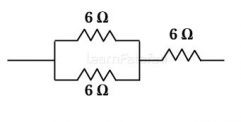
Therefore, equivalent resistance will be 1 / ((1/6)+(1/6)) = 6 x 6 / 6 + 6 = 3 Ω
To these parallel resistors one resistor of 6Ω is connected in series. Therefore, total resistance is 3Ω + 6Ω = 9Ω
Let’s connect two resistors in series and one resistor parallel to it. Consider following figure.
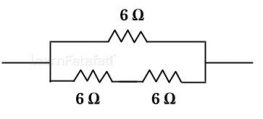
Here equivalent resistance in series is 6Ω + 6Ω = 12Ω. Also one resistor of 6Ω is connected parallel to series resistor
∴ 1/ (1/12 + 1/6) = 12 x 6 / 12 + 6 = 4Ω
12. Several electric bulbs designed to be used on a 220 V electric supply line, are rated 10 W. How many lamps can be connected in parallel with each other across the two wires of 220 V line if the maximum allowable current is 5 A?
Answer: Given: Potential difference (V) = 220 V
Power (P) = 10 W
Let R1 be the resistance of the bulb. Therefore
P1= V2 / R1
∴ R1 = V2 / P1
∴ R1 = (220)2/ 10 = 4840 Ω
Using Ohm’s law,
V = IR
Therefore, R = V/ I
∴ R = 220 / 5 = 44 Ω
∴ 1/R = 1/R1 + 1/R1+ ….. x times
∴ 1 /R = x/ R1
∴ x = R1 / R = 4840 / 44 = 110
Therefore, 110 electric bulb are connected in parallel.
13. A hot plate of an electric oven connected to a 220 V line has two resistance coils A and B, each of 24 Ω resistance, which may be used separately, in series, or in parallel. What are the currents in the three cases?
Answer: Given: Potential difference (V) = 220 V
Resistance of one coil in oven (R) = 24 Ω
Case i) When coils are used separately :
By Ohm’s Law,
V = I1R1
Therefore, I1 = V / R1 = 220 / 24 = 9.16A
When coils are used separately then current passing through the coil will be 9.16 A.
Case ii) When coils are used in series:
Let R2 be the equivalent resistance in series.
Therefore, R2 = 24Ω + 24Ω = 48Ω
Using Ohm’s law,
V = I2R2
∴ I2 = V / R2 = 220 / 48 = 4.58 A
Case iii) When coils are connected in parallel
Let R3 be the equivalent resistance in parallel
R3 = 1 / [(1/24)+(1/24)] = 24 / 2 = 12 Ω
Using Ohm’s law,
V = I3R3
∴ I3 = V / R3
∴ I3 = 220 / 12 = 18.33 A
14. Compare the power used in the 2 Ω resistor in each of the following circuits: (i) a 6 V battery in series with 1 Ω and 2 Ω resistors, and (ii) a 4 V battery in parallel with 12 Ω and 2 Ω resistors.
Answer: i) Potential difference V = 6V
Resistors of 1Ω and 2Ω are connected in series combination. Equivalent resistance in circuit of series combination can be given as R = 1+2 = 3Ω
Using Ohm’s law,
V= IR
∴ I = V/R = 6 / 3 = 2A
As circuit is in series combination, there is no division in the circuit and current of 2 A will flow through each and every component of the circuit.
This suggest that current of 2 A flows through the resistor of 2Ω.
By using the formula for Power,
P = I2R = 22 x 2 = 8 W
ii)Potential difference V = 4V
Resistors 12Ω and 2Ω are connected parallel to each other. Also, voltage across each component in a parallel circuit is same. Therefore, voltage across the parallel circuit will be 4V
Thus, power consumed by 2Ω resister will be,
P= V2/R = 42 / 2 = 16/2 = 8W
15. Two lamps, one rated 100W at 220V, and the other 60W at 220V, are connected in parallel to electric mains supply. What current is drawn from the line if the supply voltage is 220V?
Answer: Lamps are connected in parallel combination, therefore there is no division and same amount of voltage will pass through the circuit.
We know that Power P = Voltage (V) x Current (I)
∴ I = P / V
Therefore, current drawn through the lamp of 100 W will be,
I = 100 W / 220 V = 0.45 A
Also, current drawn through the lamp of 60 W will be,
I = 60 W / 220 V = 0.27 A
Therefore current drawn from the line will be 0.45 + 0.27 = 0.72 A
16. Which uses more energy, a 250 W TV set in 1 hr, or a 1200 W toaster in 10 minutes?
Answer: Given: Power of Tv = 250W , power of toaster = 1200 W
Time for Tv= 1 hour = 3600 sec , time for toaster = 10 minute = 600 sec
Let P be the power and t be the time, therefore energy consumed by the appliance is given by
H = Pt
∴ Energy consumed by TV set in an hour = 250 x 3600 = 9 x 10⁵ J
∴ Energy consumed by toaster in 10 minutes = 1200 x 600 = 720000 = 72 x 104 J or 7.2 x 10⁵ J
17. An electric heater of resistance 8 Ω draws 15 A from the service mains 2 hours. Calculate the rate at which heat is developed in the heater.
Answer: Resistance R = 8Ω, current I = 15 A
Using the formula,
P = I2R
∴ P = (15)2 x 8 = 1800 J
18. Explain the following.
(a) Why is the tungsten used almost exclusively for filament of electric lamps?
Answer: Melting point of tungsten is very high. Also, at high temperature it doesn’t burn easily. Therefore, tungsten is used exclusively for filament of electric lamps.
(b) Why are the conductors of electric heating devices, such as bread-toasters and electric irons, made of an alloy rather than a pure metal?
Answer: Alloy has more resistivity than metals, also,heat producing ability of alloy is more as compared to metals. Therefore, electric heating devices like bread toasters and iron are made of alloy rather than pure metal.
(c) Why is the series arrangement not used for domestic circuits?
Answer: Series arrangement is not use in domestic circuits. This is because in series circuit there is voltage division due to which components in the circuit receives small amount of voltage. Therefore, amount of current in the circuit decreases and device becomes hot.
(d) How does the resistance of a wire vary with its area of cross-section?
Answer: Resistance of wire is inversely proportional to area of cross section given by the expression, R ∝ 1/A.
(e) Why are copper and aluminium wires usually employed for electricity transmission?
Answer: Wires of copper and aluminium has low resistivity. Moreover copper and aluminium are good conductor of electricity. Thus, these are usually employed for electricity transmission.
Check other lessons NCERT Solutions for Class 10
Download free NCERT textbook class 10 Science – Chapter 12 Electricity
CBSE Class 10
Access Class 10 video lessons online (internet required) or offline(internet not required) in SD Card, Pendrive, DVD, Tablet.
Chapter 12 -Electricity


