

- Chemical Reaction: It is a process in which reactants reacts to form products.
Zn + H2SO4 → ZnSO4 + H2
(Zinc) (Sulphuric acid) (Zinc Sulphate) (Hydrogen)
[Reactants] [Products] - Chemical Equation:
- A symbolic representation of chemical reaction in form of formula or symbol.
Direction of Reaction
2H2(g) + O2(g) → 2H2O(g)
(Hydrogen) (Oxygen) (Water)
[Reactant on Left Side] [Product on Right Side] - Physical states of compounds are indicated by:
State Denoted by Gaseous State (g) Liquid State (l) Solid State (s) Aqueous State (aq) Precipitate ↓
- A symbolic representation of chemical reaction in form of formula or symbol.
- Skeletal Chemical Equation: A chemical equation which represents reaction in terms of formula and symbols.
Mg + O2 → MgO
(Magnesium) (Oxygen) (Magnesium Oxide) - Balanced Chemical Equation: A chemical equation in which number of atoms of element on reactant side is equal to number of atoms in product side.
2Mg + O2 → 2MgO
Atoms of Reactant Side = Atoms of Product Side
[Mg=2, O=2] [Mg=2, O=2]- Steps for balancing chemical equation:
- Unbalanced equation:
Mg + O2 → MgO - Start balancing with compound containing maximum number of atoms.
Mg + O2 → 2MgO - Balance untill atoms of elements in reactant, becomes equal to atoms of elements in product.
2Mg + O2 → 2MgO - Provide with physical state.
2Mg(s) + O2(g) → 2MgO(s) - Indicate reaction condition above or below the arrow.
- Unbalanced equation:
- Steps for balancing chemical equation:
- Types of Chemical Reaction:
- Combination reaction: Two or more reactants combines to form single product.
C(s) + O2(g) → CO2(g)
(Carbon) (Oxygen) (Carbon Dioxide)
[Reactants] [Single Product] - Exothermic Reaction: Heat is evolved during reaction. e.g. Burning of Natural Gas is exothermic reaction.
CH4(g) + 2O2(g) → CO2(g) + 2H2O(g)
(Methane) (Oxygen) (Carbon Dioxide) (Water) - Decomposition Reaction: Single substance decomposes to form two or more products.
Heat
2FeSO4(s) → Fe2O3(s) + SO2(g) + SO3(g)
(Ferrous Sulfate) (Ferric Oxide) (Sulfur Dioxide) (Sulfur Trioxide)
[Single Substance] [Two or more products] - Thermal Decomposition Reaction: Decomposition reaction carried out in presence of heat.
Heat
CaCO3(s) → CaO(s) + CO2(g)
(Limestone) (Quicklime) (Carbon Dioxide) - Endothermic Reaction: Heat is absorbed during reaction.
Sunlight
2AgCl(s) → 2Ag(s) + Cl2(g)
(Silver Chloride) (Silver) (Chlorine Gas) - Displacement Reaction: One element displaces another element from its compound.
Fe(s) + CuSO4(aq) → FeSO4(aq) + Cu(s)
(Iron) (Copper Sulphate) (Iron Sulphate) (Copper) - Double Displacement Reaction: Two different atoms or groups of atoms are exchanged during the reaction.
Na2SO4(aq) + BaCl2(aq) → BaSO4(s) + 2NaCl(aq)
(Sodium Sulphate) (Barium Chloride) (Barium Sulphate) (Sodium Chloride) - Precipitation Reaction: Reaction involving formation of precipitate.
Na2SO4(aq) + BaCl2(aq) → BaSO4(s) ↓ + 2NaCl(aq)
(Sodium Sulphate) (Barium Chloride) (Barium Sulphate) (Sodium Chloride) - Oxidation Reaction: Gain of Oxygen or Loss of Hydrogen.
Heat
2Cu + O2 → 2CuO
(Copper) (Oxygen) (Copper Oxide) - Reduction Reaction: Gain of Hydrogen or Loss of Oxygen.
CuO + H2 → Cu + H2O
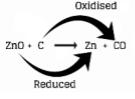
(Copper Oxide) (Hydrogen) (Copper) (Water) - Redox Reaction: Oxidation and reduction occur simultaneously, where, one reactant get oxidised while other reactant get reduced.
- Combination reaction: Two or more reactants combines to form single product.
- Effects of oxidation:
- Corrosion: Rusting of metals due to corrosive substances (moisture in air, acids, etc). It can be prevented by painting metal surfaces.
- Rancidity: Oxidation of fats and oils that changes their taste and smell. It can be prevented by adding antioxidants to substance containing oils and fats.
Textbook simplified in Videos