

NCERT Solutions for Class 8 Science
Chapter 14 Chemical Effects of Electric Current
LearnFatafat offers free NCERT Solutions for Class 8 Science Chapter 14 Chemical Effects of Electric Current. Chapter covers the topics like do liquids conduct electricity?, chemical effect of electric current, electroplating, uses of electroplating and more. Check video lessons and MCQ quizzes for Class 8 Science Chapter 14 Chemical Effects of Electric Current click here to buy.
NCERT Solutions for Class 8 Science Chapter 14 Chemical Effects of Electric Current
1. Fill in the blanks.
(a) Most liquids that conduct electricity are solutions of,______________ and ______________.
Answer: acids bases and salts
(b) The passage of an electric current through a solution causes ______________ effects.
Answer: chemical
(c) If you pass current through copper sulphate solution, copper gets deposited on the plate connected to the terminal of the battery.
Answer: negative
(d) The process of depositing a layer of any desired metal on another material by means of electricity is called .
Answer: electroplating
2. When the free ends of a tester are dipped into a solution, the magnetic needle shows deflection. Can you explain the reason?
Answer: Magnetic needle show deflection when current is passed through the circuit. When free ends of a tester are dipped into a solution, magnetic needle shows deflection. This suggests that circuit is complete and solution is a conducting solution. Thus, current passes through the circuit due to which magnetic needle shows deflection.
3. Name three liquids, which when tested in the manner shown in Fig.14.9, may cause the magnetic needle to deflect.
Answer: For deflection of magnetic needle, current must pass through the circuit. For this, solution must be conducting solution. Some of the conducting solution are lemon juice, salty water, soap solution, etc.
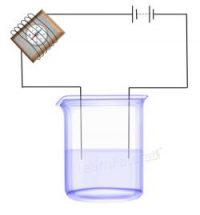
4. The bulb does not glow in the setup shown in Fig.14.10. List the possible reasons. Explain your answer
Answer:

Reasons could be –
- Use of fused bulb
- Solution used must be non conducting
- Battery used may be exhausted
- Solution used must be of low conductivity, that passes weak current. This current could be insufficient for the bulb to glow.
5. A tester is used to check the conduction of electricity through two liquids, labelled A and B. It is found that the bulb of the tester glows brightly for liquid A while it glows very dimly for liquid B. You would conclude that
(i) liquid A is a better conductor than liquid B.
(ii) liquid B is a better conductor than liquid A.
(iii) both liquids are equally conducting.
(iv) conducting properties of liquid cannot be compared in this manner.
Answer: (i) liquid A is a better conductor than liquid B.
Conductivity of liquid suggest the amount of current passing through it. When conductivity is high, more current is passed through the solution therefore, bulb glows brighter. When conductivity is low, less current passes through the solution, therefore, bulb glows dim.
6. Does pure water conduct electricity? If not, what can we do to make it conducting?
Answer: Pure water do not conduct electricity. To make pure water conducting, add small amount of salt or lemon juice in water.
7. In case of a fire, before the firemen use the water hoses, they shut off the main electrical supply for the area. Explain why they do this.
Answer: In case of fire, firemen shut off main electrical supply of area because water is good conductor of electricity. If water get poured on electrical machines at home, current will get conducted through water, which can harm firemen.
8. A child staying in a coastal region tests the drinking water and also the seawater with his tester. He finds that the compass needle deflects more in the case of seawater. Can you explain the reason?
Answer: Sea water contains salts in large amount, therefore it allows the passage of current through it, thereby showing deflection in the compass needle. As compared to seawater, drinking water contains less amount of salts. Therefore, conductivity is low and thus, compass needle shows less deflection.
9. Is it safe for the electrician to carry out electrical repairs outdoors during heavy downpour? Explain.
Answer: No, during rain it is not safe for electrician to carry out repair outdoor. This is because, rainwater contains some amount of salts and can conduct electricity. If electrician is repairing outdoors during rain he could get a shock which can prove fatal to life.
10. Paheli had heard that rainwater is as good as distilled water. So she collected some rainwater in a clean glass tumbler and tested it using a tester. To her surprise she found that the compass needle showed deflection. What could be the reasons?
Answer: Rainwater contains salts dissolved in it. This makes rainwater conducting. Distilled water do not contains dissolved salts. Thus, current passes through rainwater due to which deflection of compass needle was observed.
11. Prepare a list of objects around you that are electroplated.
Answer: 1) Chromium plating is done on parts of vehicles. 2) Silver jewellery are coated with gold to give them gold appearance. 3) Iron used on construction sites are coated with layer of zinc to prevent it from corrosion.
12. The process that you saw in Activity 14.7 is used for purification of copper. A thin plate of pure copper and a thick rod of impure copper are used as electrodes. Copper from impure rod is sought to be transferred to the thin copper plate. Which electrode should be attached to the positive terminal of the battery and why?
Answer: As copper ions are positively charged, they get attracted towards the plate connected to the negative terminal of the battery. Copper ions are transferred to thin plate therefore, this thin plate should be connected to the negative terminal. Thus, impure rod of copper should be attached to positive terminal.
Check other lessons NCERT Solutions for Class 8
Download free NCERT textbook class 8 Science – Chapter 14 Chemical Effects of Electric Current
CBSE Class 8
Access Class 8 video lessons online (internet required) or offline(internet not required) in SD Card, Pendrive, DVD, Tablet.
Chapter 14 – Chemical Effects of Electric Current