

NCERT Solutions for Class 8 Science
Chapter 6 Combustion and Flame
LearnFatafat offers free NCERT Solutions for Class 8 Science Chapter 6 Combustion And Flame. Chapter covers the topics like what is combustion, conditions for combustion, types of combustion reactions, ignition temperature, fire control, flame, fuels and more. Check video lessons and MCQ quizzes for Class 8 Science Chapter 6 Combustion And Flame click here to buy.
NCERT Solutions for Class 8 Science Chapter 6 Combustion and Flame
1. List conditions under which combustion can take place.
Answer: Combustion is burning of substance in presence of oxygen. Following are the conditions under which combustion takes place –
- Presence of oxygen
- Presence of fuel
- Ignition temperature
2. Fill in the blanks.
(a) Burning of wood and coal causes _________of air.
Answer: pollution
(b) A liquid fuel, used in homes is ___________.
Answer: liquefied petroleum gas
(c) Fuel must be heated to its__________ _________ before it starts burning.
Answer: ignition temperature
(d) Fire produced by oil cannot be controlled by _________.
Answer: water
3. Explain how the use of CNG in automobiles has reduced pollution in our cities.
Answer: Combustion of petroleum produces carbon monoxide gas. It causes respiratory disease. Use of CNG in automobiles produces very less amount of harmful product. Thus, it helps in reducing pollution.
4. Compare LPG and wood as fuels.
Answer: Wood is used as tradition method of fuel. Wood causes pollution by producing smoke. Also, wood is obtained from trees, thus, using wood as fuel will involve cutting of tree, which is bad for environment. If LPG is used as a fuel, it does not produce smoke or other harmful pollutants. Moreover, LPG is more efficient than wood in terms of heat production.
5. Give reasons.
(a) Water is not used to control fires involving electrical equipment.
Answer: Water is not used for controlling fires involving electrical equipment because water is good conductor electricity. Person controlling fire with water will get a shock or it can damage electrical equipment. Also it can transfer current in all areas through water.
(b) LPG is a better domestic fuel than wood.
Answer: LPG produces very less smoke or other harmful pollutants in comparison to wood. Moreover, LPG is more efficient than wood in terms of heat production.
(c) Paper by itself catches fire easily whereas a piece of paper wrapped around an aluminium pipe does not.
Answer: Paper wrapped around an aluminium pipe does not catches fire because heat absorbed by paper is transferred to aluminium. Aluminium being metal is good conductor. Thus heat get transferred to aluminium and paper does not reach at its ignition temperature.
6. Make a labelled diagram of a candle flame.
Answer:
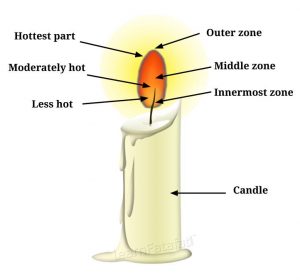
7. Name the unit in which the calorific value of a fuel is expressed.
Answer: CO2 is heavier than oxygen, when sprayed on fire it breaks the contact of fuel and oxygen, thereby controlling fire. In cylinders, carbon dioxide is stored in liquid form, while extinguishing fire, it expands and cools down and lowers the temperature of fuel. Thus, it controls fires.
9. It is difficult to burn a heap of green leaves but dry leaves catch fire easily. Explain.
Answer: Green leaves has presence of moisture in them, this do not allow green leaves to reach its ignition temperature and thus it prevents burning. Conversely, in dry leaves moisture is absent, therefore, it easily reaches at ignition temperature thereby catching fire easily.
10. Which zone of a flame does a goldsmith use for melting gold and silver and why?
Answer: Goldsmith uses outer flame to melt gold and silver, because it is the hottest part of the flame and undergoes complete combustion.
11.
11. In an experiment 4.5 kg of a fuel was completely burnt. The heat produced was measured to be 180,000 kJ. Calculate the calorific value of the fuel.
Answer: Given: 4.5 kg fuel produces 180000 kilojules of heat.
∴ Heat produced by 1 kg of fuel = ( 180000 / 4.5 ) x 1 kJ /kg = 40000 kJ/kg
12. Can the process of rusting be called combustion? Discuss.
Answer: Combustion is chemical process in which substance reacts with oxygen and produces energy to give heat and light. In rusting, exothermic process is carried out which releases heat, thus, rusting can be named as slow combustion.
13. Abida and Ramesh were doing an experiment in which water was to be heated in a beaker. Abida kept the beaker near the wick in the yellow part of the candle flame. Ramesh kept the beaker in the outermost part of the flame. Whose water will get heated in a shorter time?
Answer: Water in Ramesh’s beaker will get heated in less time, as he has kept beaker in outermost part of the flame, which is the hottest part. Water from Abida beaker will get heated in longer time as she has kept beaker near the wick in the yellow part of the candle flame which is less hot than outer part of flame.
Check other lessons NCERT Solutions for Class 8
Download free NCERT textbook class 8 Science – Chapter 6 Combustion and Flame
CBSE Class 8
Access Class 8 video lessons online (internet required) or offline(internet not required) in SD Card, Pendrive, DVD, Tablet.
Chapter 6 – Combustion and Flame